Germany: 14 Days Before the Kenntnisprüfung, Practise Cases
In the final 14 days before the Kenntnisprüfung in Germany, practise spoken emergency cases, examination language and mock-exam corrections.
Ahmed Quteishat
Founder, Klaro
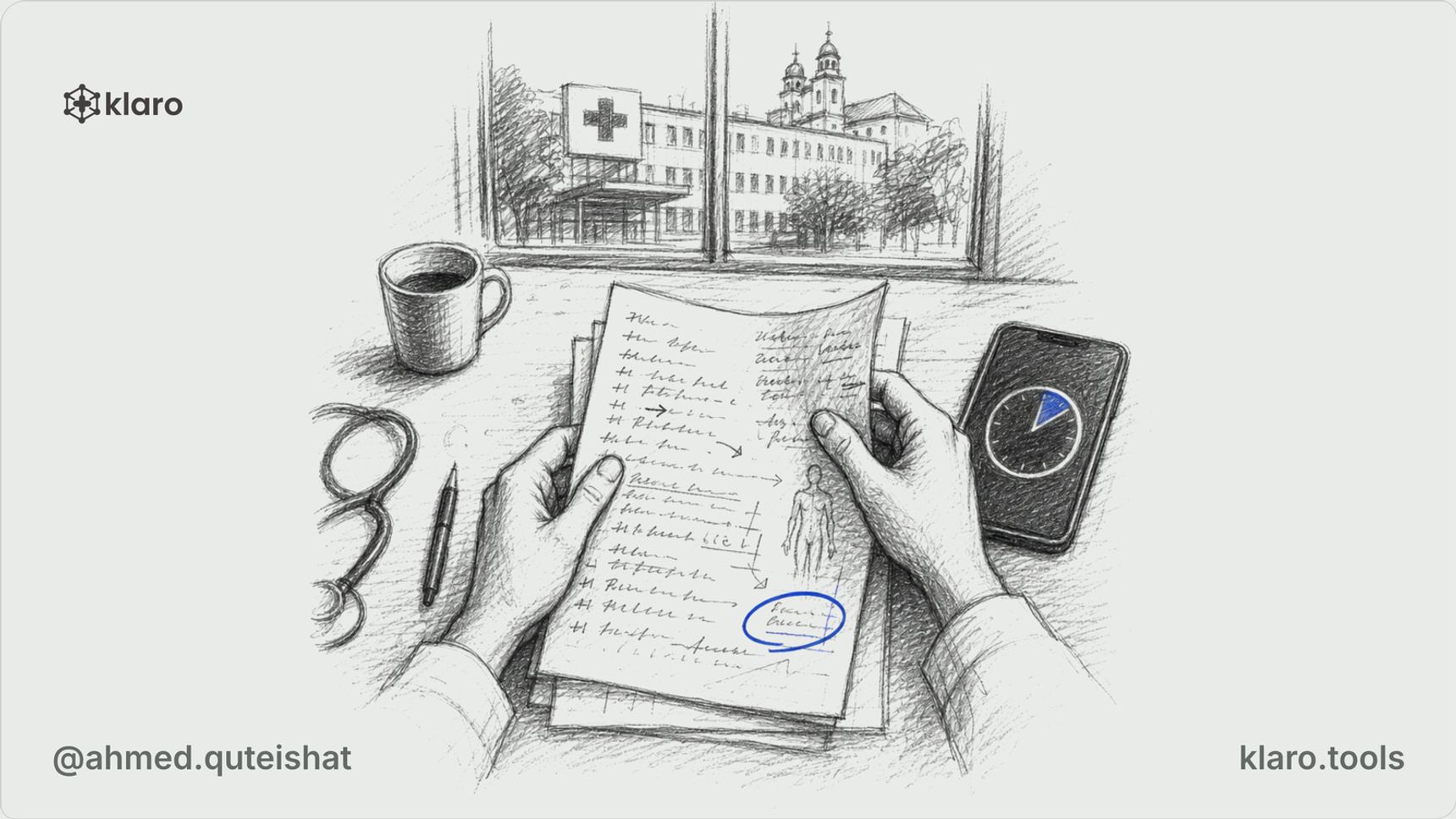
In the final 14 days before the Kenntnisprüfung, practise spoken emergency cases and correct your weak answers instead of collecting more notes. The Kenntnisprüfung is the medical knowledge examination used when an authority finds important differences between your degree and German medical training. At this stage, another 300-page PDF rarely changes your result. A case at a desk, spoken aloud under pressure, does.
This is the pattern behind many first-attempt passes. Candidates stop studying by subject alone. They practise how to receive a patient, name danger signs, examine the patient, order tests, give the first treatment and explain the next step to an examiner.
What the exam asks you to do
The Kenntnisprüfung is an oral-practical examination, not a written multiple-choice paper. The exact organisation comes from the Approbation authority in your Bundesland, meaning your German state. A commission commonly gives you a patient case and asks follow-up questions on diagnosis, differential diagnoses, tests, treatment and complications.
Internal medicine and surgery form the centre of the examination. Questions from emergency medicine, pharmacology, imaging, hygiene, law and other subjects appear through the patient in front of you. A chest-pain case can become acute coronary syndrome, aortic dissection, pulmonary embolism, anticoagulation, ECG changes and informed consent.
Use one spoken case structure
Use the same order for every case. It prevents silence when the examiner changes the diagnosis. Put a blank A4 sheet beside you and say the headings aloud until they become automatic.
- Start with urgency: “I first check airway, breathing, circulation, consciousness and vital signs.” Name the immediate danger, such as shock, sepsis, stroke or active bleeding.
- Take a focused history. Ask about onset, location, severity, allergies, medicines, pregnancy, operations and key risks such as smoking or anticoagulants.
- Describe the examination in order. For abdominal pain, say inspection, auscultation, palpation, percussion, rectal examination when indicated, then vital signs.
- Name 2 or 3 likely diagnoses. Explain which finding would separate them, such as ECG changes, troponin, ultrasound, CT or blood cultures.
- Give the first treatment. Name oxygen only when indicated, IV access, fluids, analgesia, antibiotics, anticoagulation, surgery consult or intensive care, depending on the case.
- Finish with monitoring and disposition. Say where the patient goes: emergency room observation, normal ward, intensive care unit or operating theatre.
What to practise on days 14 to 8
Spend the first week on emergency reasoning. Pick 2 cases each day and speak for 10 minutes per case. Use a timer, a chair as the examiner’s seat and a notebook for the questions you could not answer. Do not read a model answer first.
Choose cases that force a first decision in the first minute: septic shock, acute coronary syndrome, pulmonary embolism, stroke, upper gastrointestinal bleeding, acute abdomen, anaphylaxis, diabetic ketoacidosis and acute kidney injury. These cases contain blood pressure, ECG, blood gas, CT, medication doses and admission decisions that examiners can explore.
After each case, write only 3 corrections. For example: “I forgot to ask about apixaban.” “I said CT before pregnancy test.” “I did not name the surgical consult.” Then repeat the same case the next day without looking at your first attempt. A long error list stays closed in your notebook. Three corrected sentences return in the next answer.
What to practise on days 7 to 3
Use this week for German examination language. You do not need elegant German. You need short sentences that show an ordered medical examination. Say them while examining a friend, a pillow or an imaginary patient on a hospital bed.
- “Ich messe zuerst Blutdruck, Puls, Sauerstoffsättigung und Temperatur.” This means: I first measure blood pressure, pulse, oxygen saturation and temperature.
- “Ich möchte einen venösen Zugang legen und Blut abnehmen.” This means: I want to place IV access and take blood.
- “Meine Verdachtsdiagnose ist …” This means: my suspected diagnosis is …
- “Differentialdiagnostisch denke ich an …” This means: my alternative diagnoses include …
- “Ich würde die Patientin engmaschig überwachen.” This means: I would monitor the patient closely.
Book 2 mock examinations with a doctor who interrupts you. A friendly study partner who lets you finish a memorised speech is less useful. Ask the examiner to stop you after each vague sentence, especially after “I would do laboratory tests” or “I would treat accordingly.” Replace it with the blood test, scan, medicine or specialist you mean.
What to do in the final 48 hours
In the final 48 hours, do not start cardiology, surgery or pharmacology from page 1. Repeat your corrected cases, your emergency opening sentence and the German phrases you use during examination. Pack your invitation letter, passport or identity document, glasses, water and the route to the exam building the evening before.
Sleep is part of the examination. A candidate who has rehearsed 20 spoken cases can answer a new case with structure. A candidate who spent the night reading 20 new chapters loses the first question while searching for a perfect diagnosis.
What to do today
- Write 9 emergency cases on separate sheets: sepsis, chest pain, stroke, bleeding, pulmonary embolism, acute abdomen, anaphylaxis, ketoacidosis and acute kidney injury.
- Record yourself answering 1 case for 10 minutes. Mark every sentence where you say “something” or “accordingly.”
- Arrange 2 mock examinations and ask the other doctor to interrupt vague answers.
- Put your exam invitation and identity document in the bag you will carry to the exam building.
Stand: 2026-09-28. This is a guide, not legal advice. Every German state has its own rules, and rules change. Check with your state's [medical chamber (Landesärztekammer)](https://www.bundesaerztekammer.de/aerztekammern) before you act.
Ahmed Quteishat — Founder, Klaro
Ahmed built Klaro after watching how much of a doctor's move to Germany gets lost in paperwork rather than medicine.