German doctors: start emergencies with ABCDE
In Germany’s knowledge exam, emergency answers start with help, ABCDE, monitoring, and the next urgent treatment.
Ahmed Quteishat
Founder, Klaro
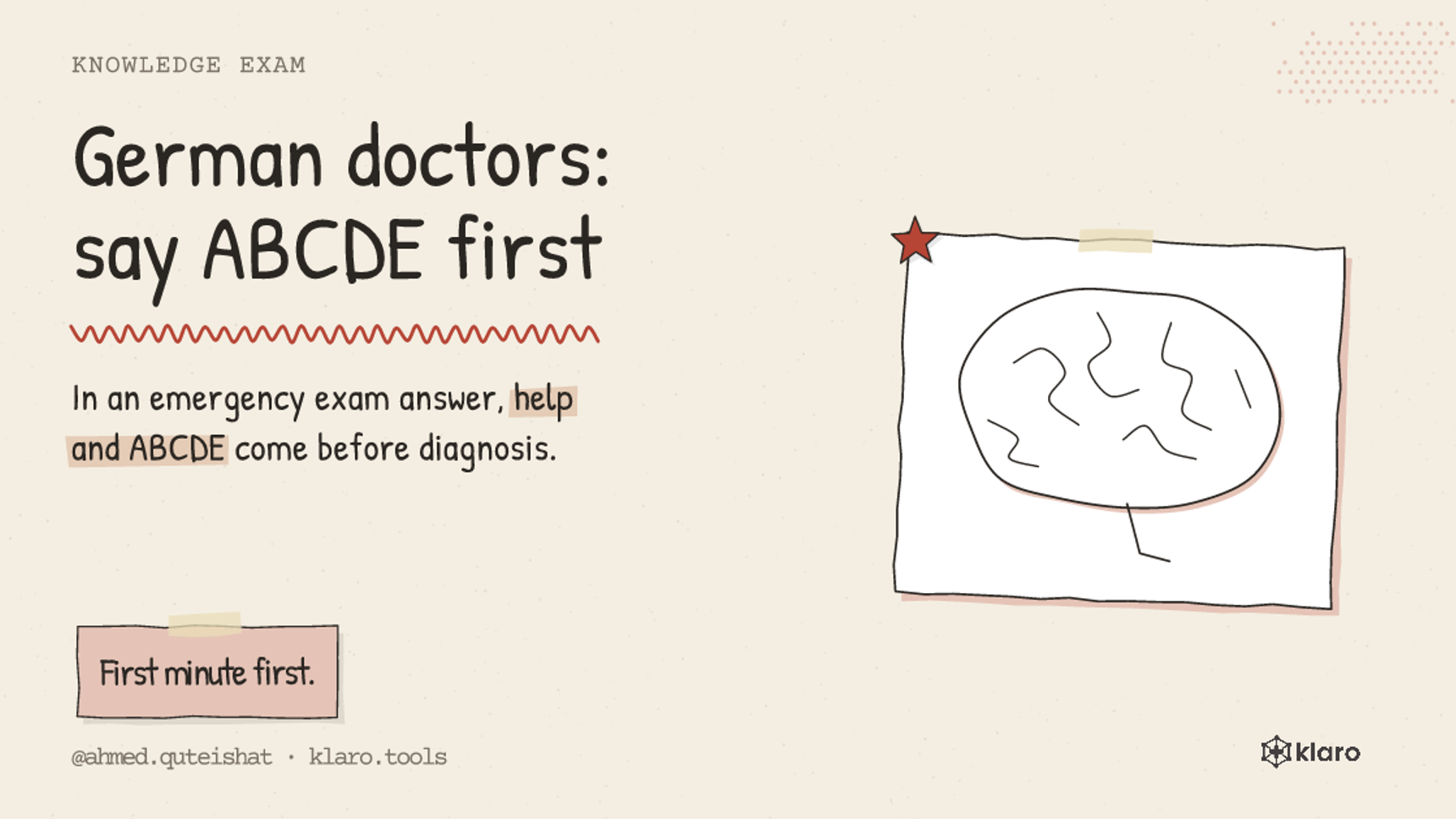
In Germany’s knowledge exam, start every emergency answer with help, ABCDE, monitoring, and urgent treatment.
Name blood tests and diagnoses only after you check immediate danger.
The knowledge exam (Kenntnisprüfung) is an oral and practical exam with a real patient.
Three examiners watch how you structure your answer under pressure.
What should you say first?
First, say you call the senior doctor and nursing team.
Then say ABCDE: airway, breathing, circulation, disability, and exposure.
Name the bedside tools you need next.
Say monitoring, blood pressure, oxygen saturation, ECG, IV access, and blood samples where needed.
This order keeps the sick patient at the centre of your answer.
Your diagnosis comes after you have checked for immediate danger.
5 emergencies to practise first
1. Chest pain
A patient has chest pain, sweat on their forehead, and low blood pressure.
Say you call for help, monitor the patient, take a 12-lead ECG, and place IV access.
Then name acute coronary syndrome, aortic dissection, pulmonary embolism, and pneumothorax as urgent possibilities.
Say that treatment follows the ECG and examination findings.
2. Sepsis
A patient has fever, confusion, fast breathing, and low blood pressure.
Say ABCDE, monitoring, IV access, blood cultures, laboratory samples, fluids, and urgent antibiotics.
Look for the infection source through the history and examination.
Check the lungs, urine, wound, and abdomen.
3. Severe allergy
A patient develops wheezing, swollen lips, and low blood pressure after a medicine.
Call for help immediately and stop the suspected medicine.
Say you give intramuscular adrenaline, oxygen, monitoring, and IV access.
Lay the patient flat and raise their legs if blood pressure is low.
4. Stroke signs
A patient suddenly has a weak arm and unclear speech.
Note the exact time they were last well and check blood glucose.
Monitor the patient and call the stroke team.
Say the patient needs urgent brain imaging.
Do not begin by listing every stroke subtype.
5. Low blood sugar
A confused patient with diabetes needs a capillary blood glucose check first.
If they are awake and can swallow, give oral glucose.
If they are unconscious, call for help and give IV glucose or glucagon.
Repeat the glucose check and find out why it fell.
Do not start with the diagnosis
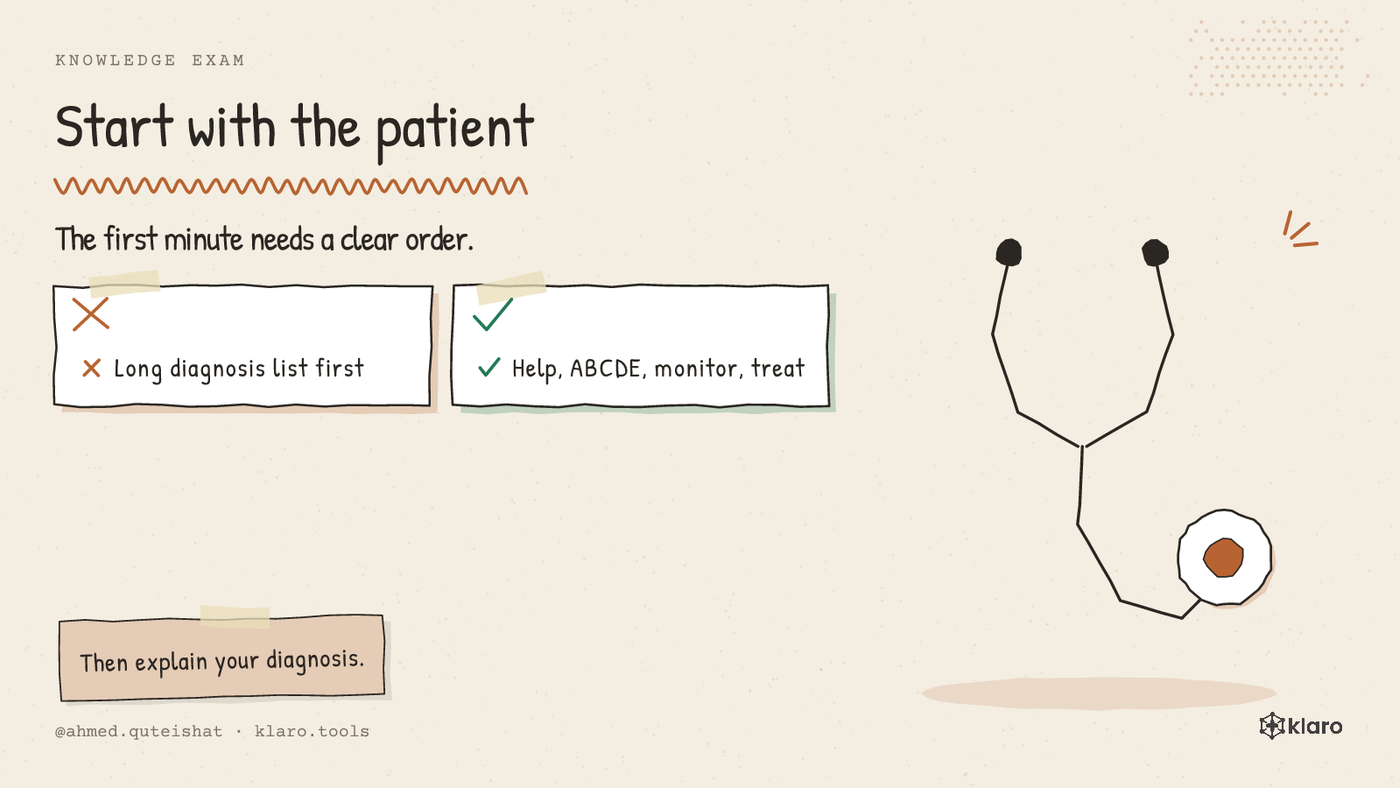
Do not start with a long list of possible diagnoses.
The examiner needs to hear what you do during the first minute.
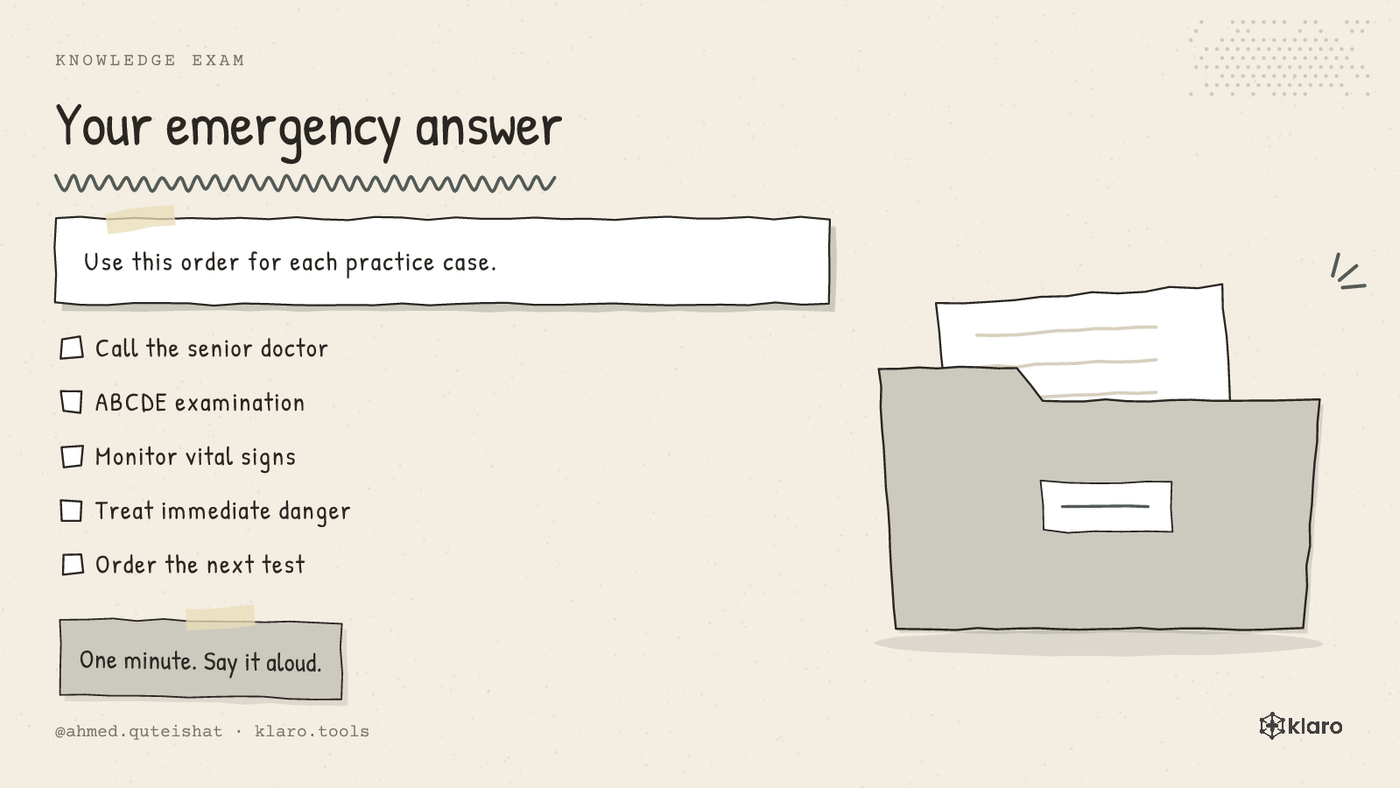
Use the same spoken frame for every emergency case.
First call for help. Then use ABCDE.
Next, monitor the patient and treat immediate danger.
Afterwards, name the tests and diagnosis.
What to do this week
- Write one ABCDE answer for chest pain, sepsis, severe allergy, stroke, and low blood sugar.
- Practise each answer aloud with a timer for 60 seconds.
- Ask your study partner to interrupt after ABCDE and request your next treatment step.
- Read the official exam rules for your state before booking an exam date.
Stand: 2026-10-16. This is a guide, not legal advice. Every German state has its own rules, and rules change. Check with your state's [medical chamber (Landesärztekammer)](https://www.bundesaerztekammer.de/aerztekammern) before you act.
Ahmed Quteishat — Founder, Klaro
Ahmed built Klaro after watching how much of a doctor's move to Germany gets lost in paperwork rather than medicine.