What Germany's Doctor Knowledge Exam Actually Tests
The German knowledge exam tests common internal medicine, surgery, emergencies and basic medical law on one real patient, not your subspecialty.
Ahmed Quteishat
Assistenzarzt, Innere Medizin (Berlin) · Founder of Klaro
The knowledge exam for foreign doctors (Kenntnisprüfung) tests common internal medicine, common surgery, emergency care and basic German medical law. It happens on one real patient, in one day. It does not test your subspecialty.
What does the exam actually test?
You take a history and examine a real patient on a hospital ward, not an actor in a classroom. Three examiners watch and then ask questions.
Most questions stay inside common internal medicine. Think diabetes, heart failure, pneumonia, stroke.
The rest stay inside common surgery cases. Think appendicitis, hernia, wound care, fractures.
You also get basic emergency questions: chest pain, anaphylaxis, the first steps of resuscitation.
The exam also checks basic German medical law. Who may sign a death certificate, for example.
They also ask about the rules for prescribing controlled drugs. And about your duty to write down patient care.
A cardiologist and a cataract surgeon get asked the same core questions.
How many examiners and how many tries?
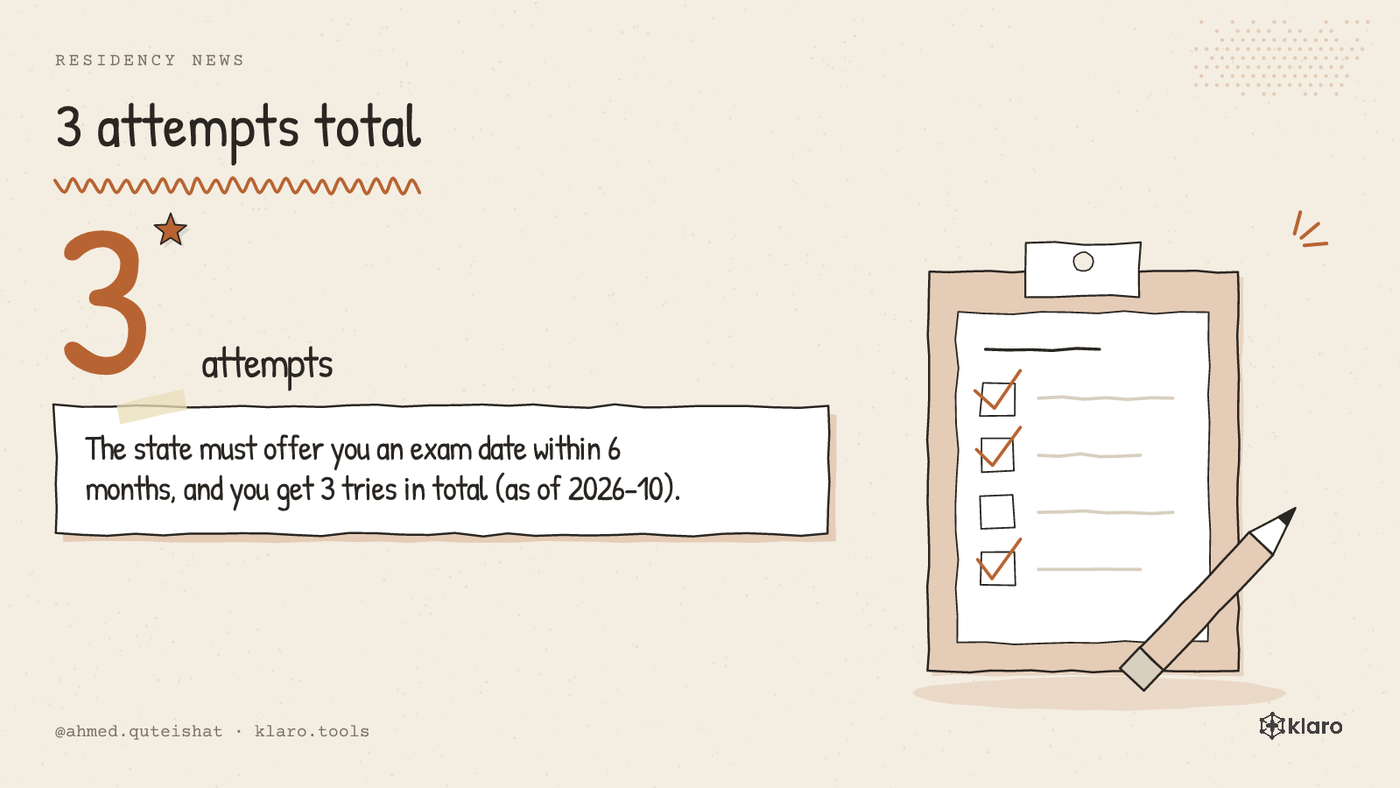
Today the exam is oral and practical, in front of 3 examiners, on a single day (as of 2026-10).
You get 3 attempts in total. The state must offer you a date within 6 months.
Is the exam changing?
A draft law, not final yet, would split the exam over 2 days (as of 2026-10). First, 30 minutes of history and examination.
Then a 60-minute written report. Then a 90 to 120 minute oral exam.
Applications filed by 31 October 2026 stay under the current one-day rules.
This is a draft. Nobody can promise it stays this way.
What matters for you now is that today's exam is still the one-day format.
When should you start sending applications?
Now, usually. Waiting for a date can take many months on its own.
A hospital contract does not need you to have passed the exam yet, in most states. Use the waiting months to drill the 4 topics above, not your whole degree.
What to do this week
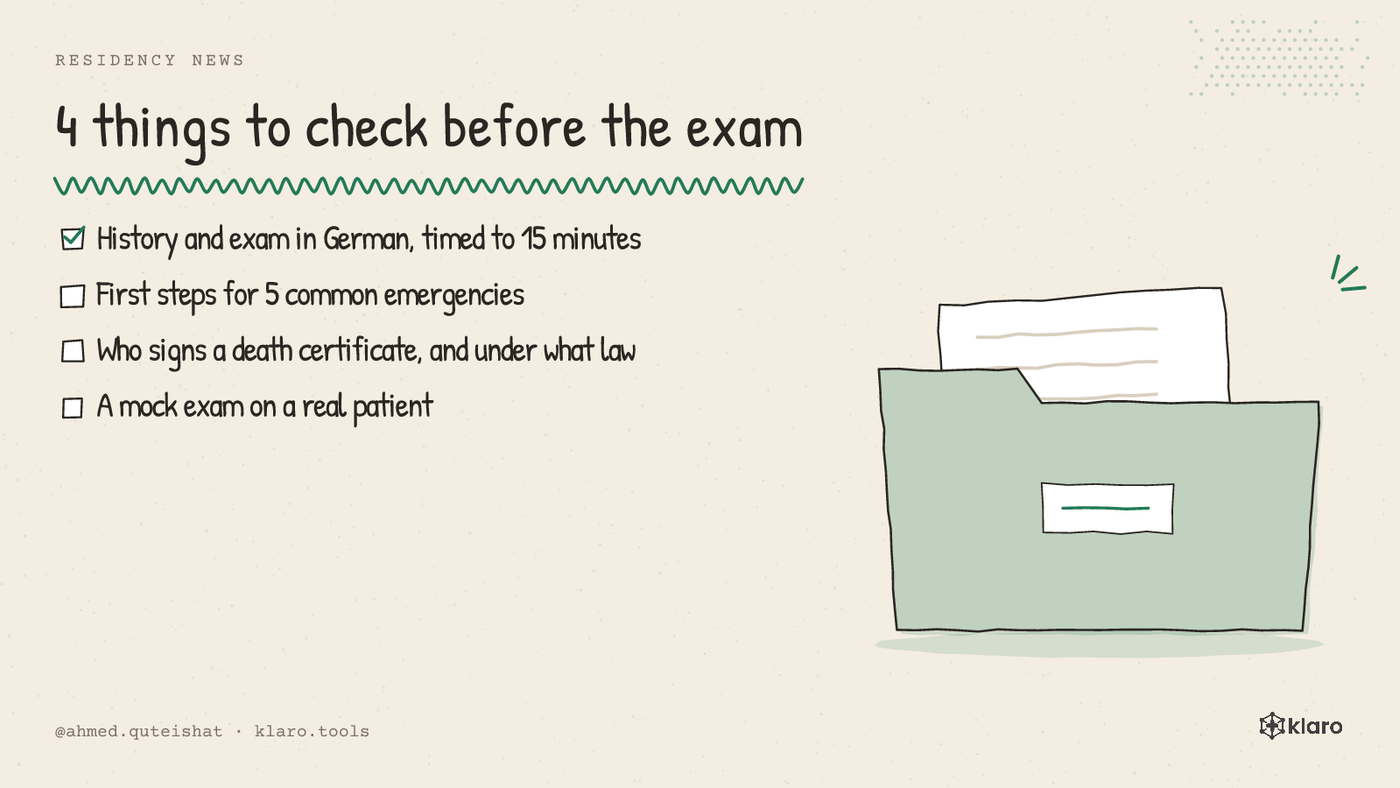
- Write out the first 3 steps for 5 common emergencies: chest pain, stroke, anaphylaxis, sepsis, a seizing patient.
- Practice a full history and exam in German on a colleague, timed to 15 minutes.
- Ask your state medical chamber in writing: who signs a death certificate, and under what law.
- Start sending hospital applications now, instead of after the exam.
Stand: 2026-11-06. This is a guide, not legal advice. Every German state has its own rules, and rules change. Check with your state's medical chamber (Landesärztekammer) before you act.
Ahmed Quteishat — Assistenzarzt, Innere Medizin (Berlin) · Founder of Klaro
Ahmed built Klaro after watching how much of a doctor's move to Germany gets lost in paperwork rather than medicine.