Your medical degree route in Germany
EU degrees that meet EU rules get automatic recognition. Other medical degrees are compared on paper before Germany requires a knowledge exam.
Ahmed Quteishat
Founder, Klaro
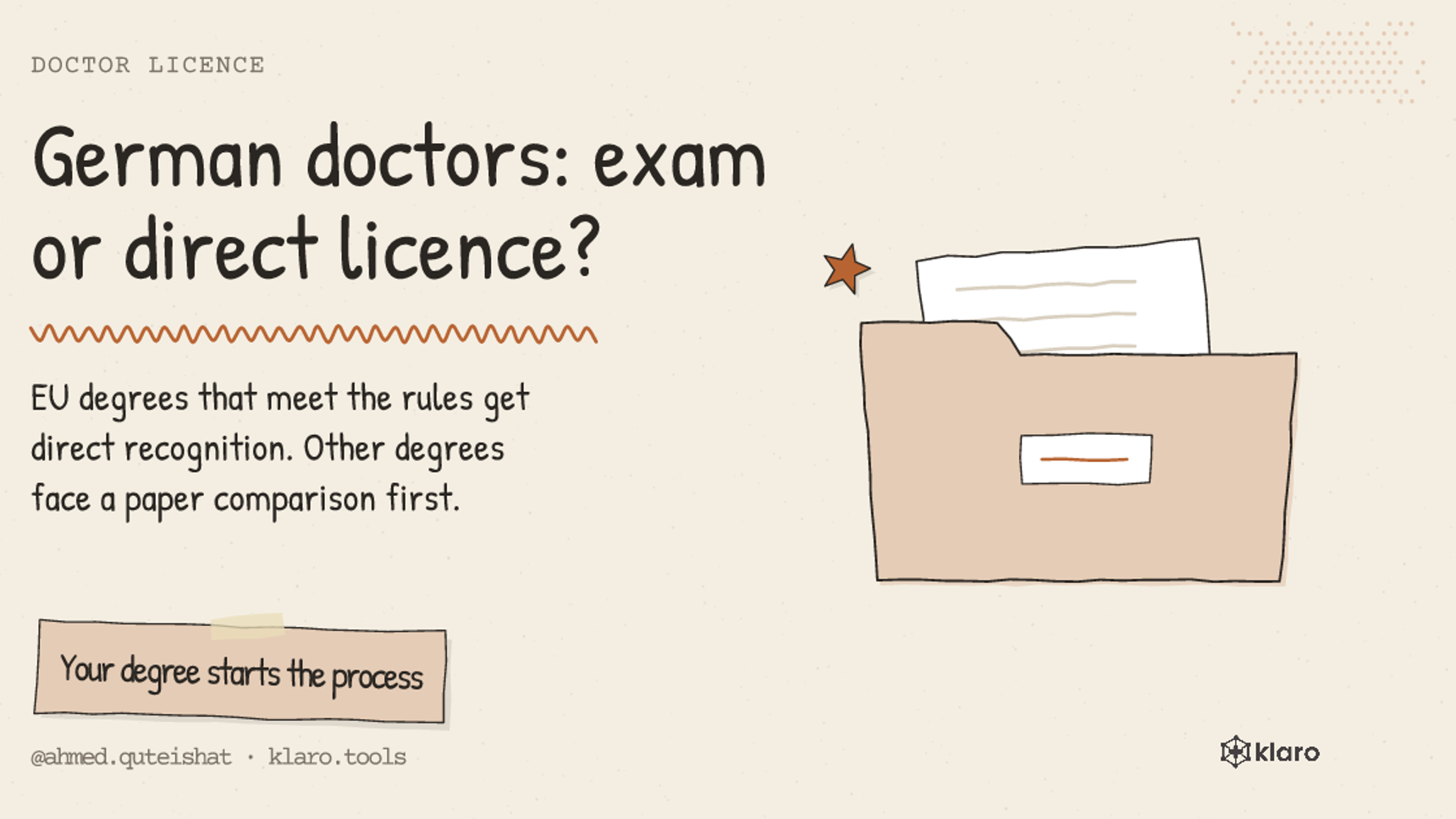
An EU medical degree that meets EU rules gets automatic recognition. Other degrees go through a paper comparison before a knowledge exam is required.
This decision comes from the licensing authority in your chosen German state. Your university name alone does not decide the result.
Start with where you qualified
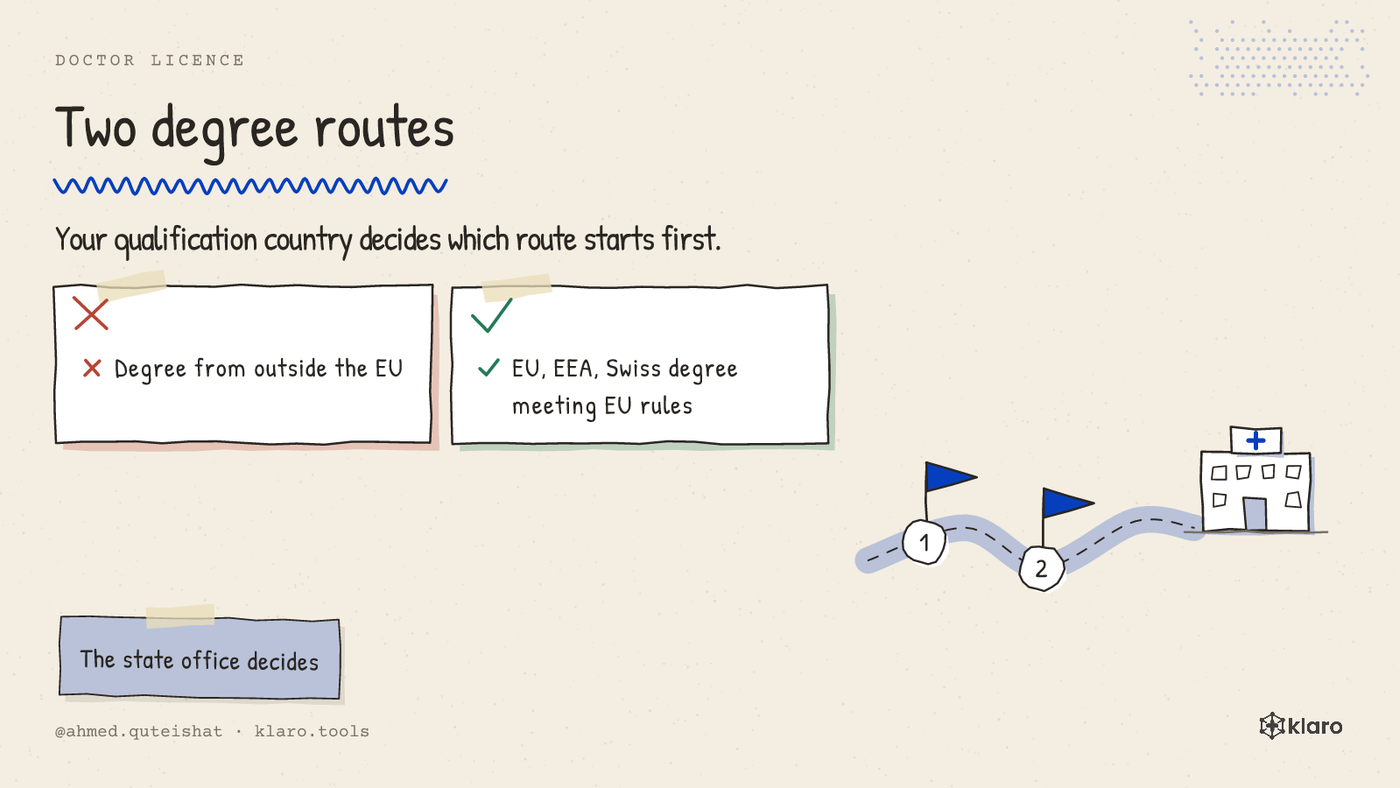
Doctors with an EU, EEA, or Swiss qualification can use automatic recognition. Your diploma must meet the EU minimum training rules for doctors.
You still need German language papers, a clean criminal record certificate, and a medical fitness certificate. Automatic recognition does not remove these licence papers.
Doctors with degrees from Egypt, India, Syria, Pakistan, Turkey, Iran, Nigeria, Jordan, and other non-EU countries take the second route. The state office compares their training with German medical training.
What the office compares
The office calls this an equivalence review (Gleichwertigkeitsprüfung). A caseworker reads your diploma, transcript, internship papers, and work certificates.
They compare subjects, clinical hours, and practical training. A detailed transcript with surgery, internal medicine, paediatrics, obstetrics, and emergency work gives them material to compare.
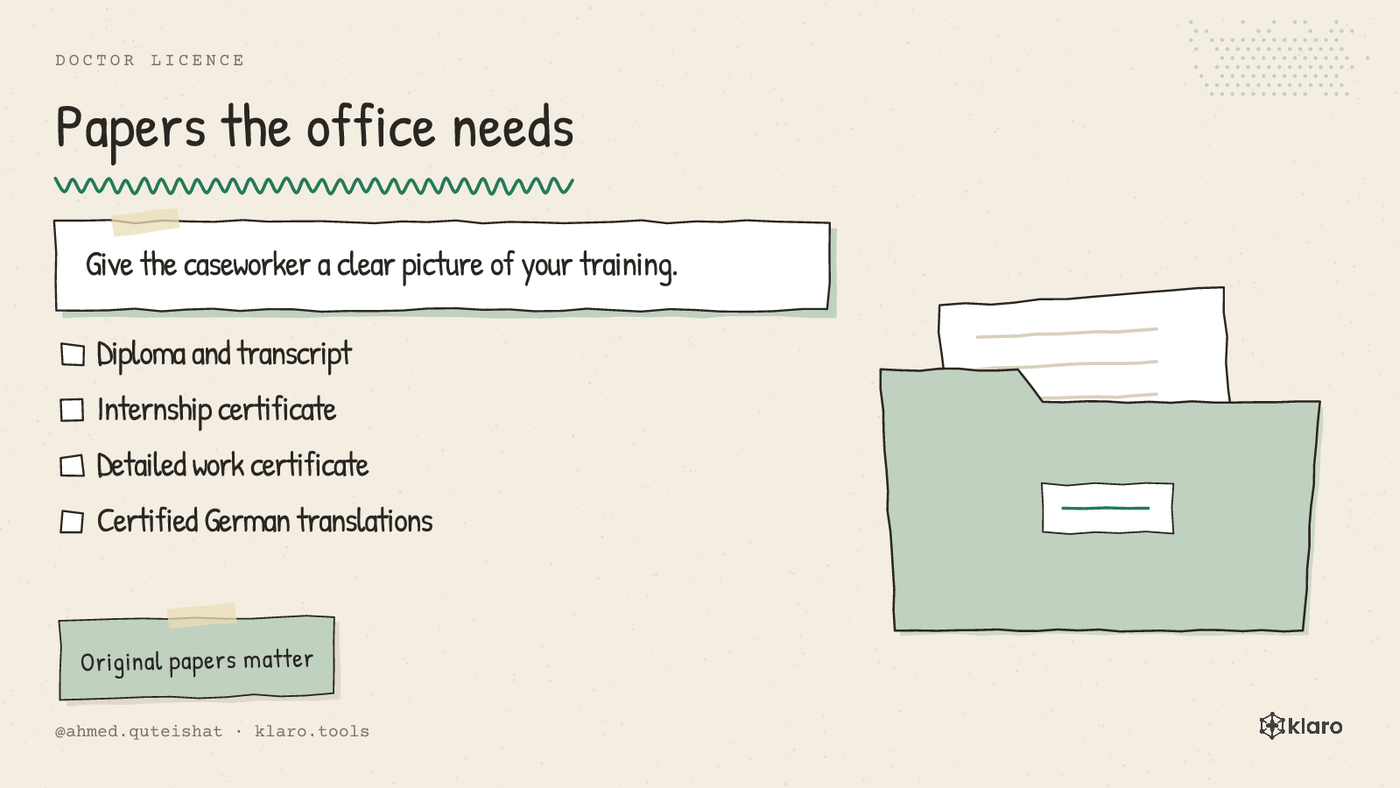
- Diploma and final transcript from your medical school
- Internship certificate with departments and dates
- Work certificates showing ward work and procedures
- Course list with clinical subjects and training hours
- Certified German translations of every required paper
A hospital job certificate can help explain missing clinical work. It does not replace a missing medical school transcript or internship certificate.
When the knowledge exam comes
The office requires the knowledge exam (Kenntnisprüfung) when it finds major differences. It can also require the exam when your school cannot provide enough papers.
The exam tests medicine at German final-year level. It normally includes internal medicine and surgery, with questions from emergency medicine, pharmacology, imaging, and law.
Work experience can reduce differences in some files. A certificate saying only “doctor” carries little weight. A letter listing admissions, ward rounds, night duty, operations, and outpatient work is stronger.
Your state makes the decision
Germany has separate licensing authorities in each state. Berlin, Bavaria, North Rhine-Westphalia, and Schleswig-Holstein process their own files and ask for their own document forms.
The legal test is the same. The paper list, translation rules, and communication with the office differ by state.
What to do now
- Choose 2 German states where you can live and work.
- Download each licensing authority’s doctor licence document list.
- Request your transcript and internship certificate from your medical school.
- Ask your hospital for a work certificate listing departments, duties, and dates.
- Send complete papers to one state authority before booking a knowledge exam course.
Stand: 2026-09-29. This is a guide, not legal advice. Every German state has its own rules, and rules change. Check with your state's [medical chamber (Landesärztekammer)](https://www.bundesaerztekammer.de/aerztekammern) before you act.
Ahmed Quteishat — Founder, Klaro
Ahmed built Klaro after watching how much of a doctor's move to Germany gets lost in paperwork rather than medicine.