Women doctors need better German orthopaedics teams
Women can train in orthopaedics in Germany, but choose the department by its daily culture, rota and senior doctors.
Ahmed Quteishat
Founder, Klaro
Women can build strong orthopaedics careers in Germany. But the department culture decides whether the job is worth taking.
Orthopaedics and trauma surgery still has many male senior doctors. That does not make every team hostile. It means you must look closely at the people, the rota and the operating list.
The specialty is not the problem
A woman junior doctor can examine fractures, reduce dislocations and assist in hip surgery. Your job title gives you the same training rights as a male colleague.
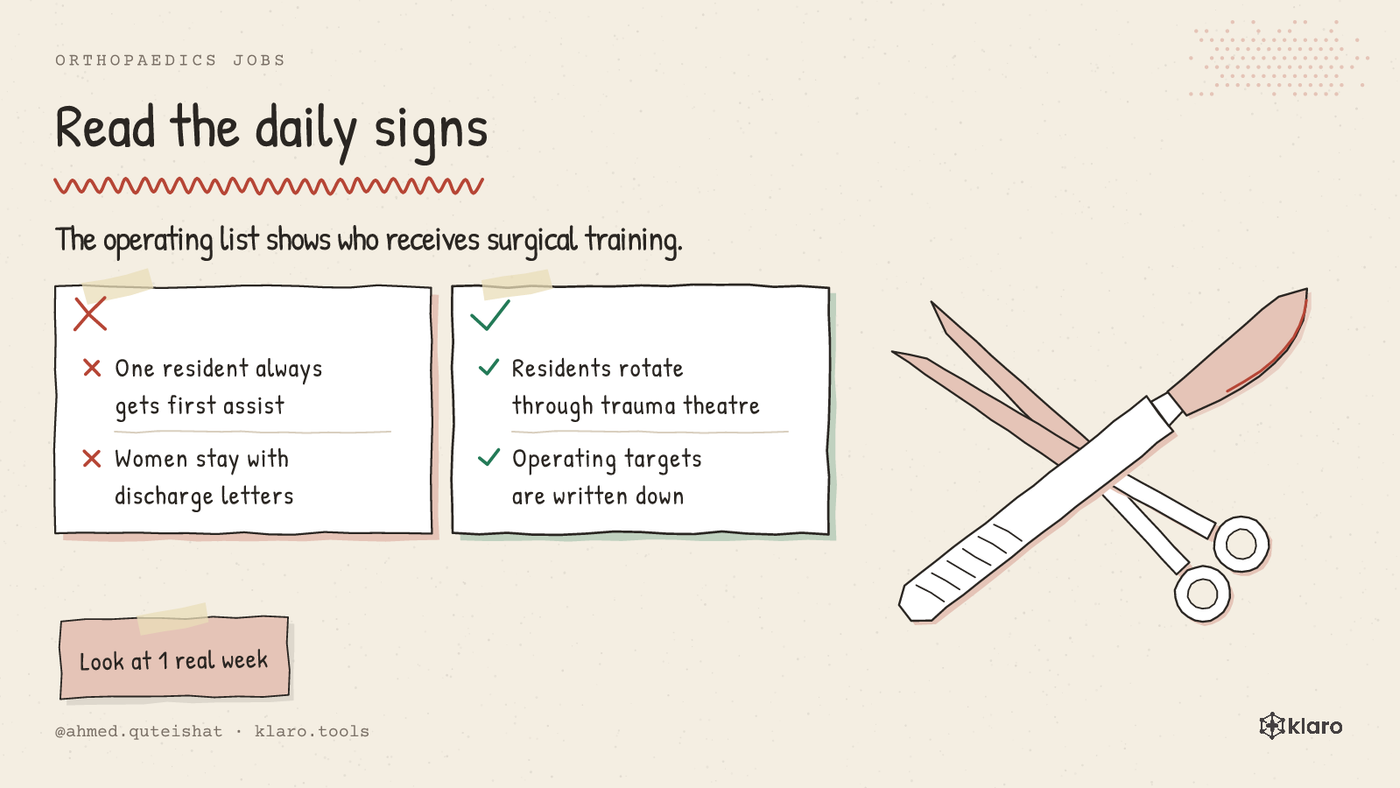
The problem appears in small daily moments. A senior doctor gives the same male resident every operation. A woman resident writes discharge letters while others go to theatre.
Some departments treat pregnancy as a staffing problem. Others change night duties early, protect you from radiation and keep you involved in ward rounds and teaching.
Germany's General Equal Treatment Act bans discrimination at work because of sex. The law matters. Still, a difficult chief can make each morning on the ward exhausting.
Look at the daily work
Do not choose a hospital because its website shows robots and complex spine surgery. Look at Tuesday morning in the emergency room.
Ask who sees trauma admissions after 5pm. Ask who closes wounds. Ask which junior doctor gets to scrub for knee replacements.
A fair department has a written rota. It shares night and weekend duty fairly. It gives each resident named operating targets in the training record.
Ask women already working there
Speak to a woman junior doctor without the chief present. Ask her after a ward round, or send a short LinkedIn message.
Ask direct questions. Do not ask whether the team is nice. Most people will say yes, even when the rota tells another story.
- How many women are junior doctors, senior doctors and consultants?
- Who gets the first assist role during trauma operations?
- What happens when a resident becomes pregnant?
- Do residents return from parental leave to theatre work?
- Who changes the rota when night duty becomes unsafe?
What pregnancy changes
Pregnancy does not end your surgical training in Germany. The hospital must complete a workplace risk check after you tell them.
Radiation, infection risks, heavy lifting and night work need a written decision. The exact work limits depend on the risk check and your state rules.
You may spend time in clinic, ward work or outpatient care instead of trauma theatre. Ask how the department keeps your training record moving during that period.
Choose the people carefully
A small hospital with one supportive senior doctor can teach you more than a famous clinic. You need operating time, honest feedback and a fair rota.
Leave if the same pattern continues for months. Repeatedly being kept from theatre is a department problem, not a sign that women do not belong in orthopaedics.
What to do before signing
- Ask for the last 4 weeks of the junior doctor rota.
- Ask a woman resident who operated during her last trauma shift.
- Ask the chief: how do you handle pregnancy and radiation work?
- Ask for the training record and the operating targets for year 1.
- Write down the answers before you compare contracts.
Stand: 2026-10-03. This is a guide, not legal advice. Every German state has its own rules, and rules change. Check with your state's [medical chamber (Landesärztekammer)](https://www.bundesaerztekammer.de/aerztekammern) before you act.
Ahmed Quteishat — Founder, Klaro
Ahmed built Klaro after watching how much of a doctor's move to Germany gets lost in paperwork rather than medicine.