Who you meet in Germany’s language exam
Germany’s medical language exam uses one clinical case in 3 parts: a patient interview, a written report, and a handover to a doctor examiner.
Ahmed Quteishat
Founder, Klaro
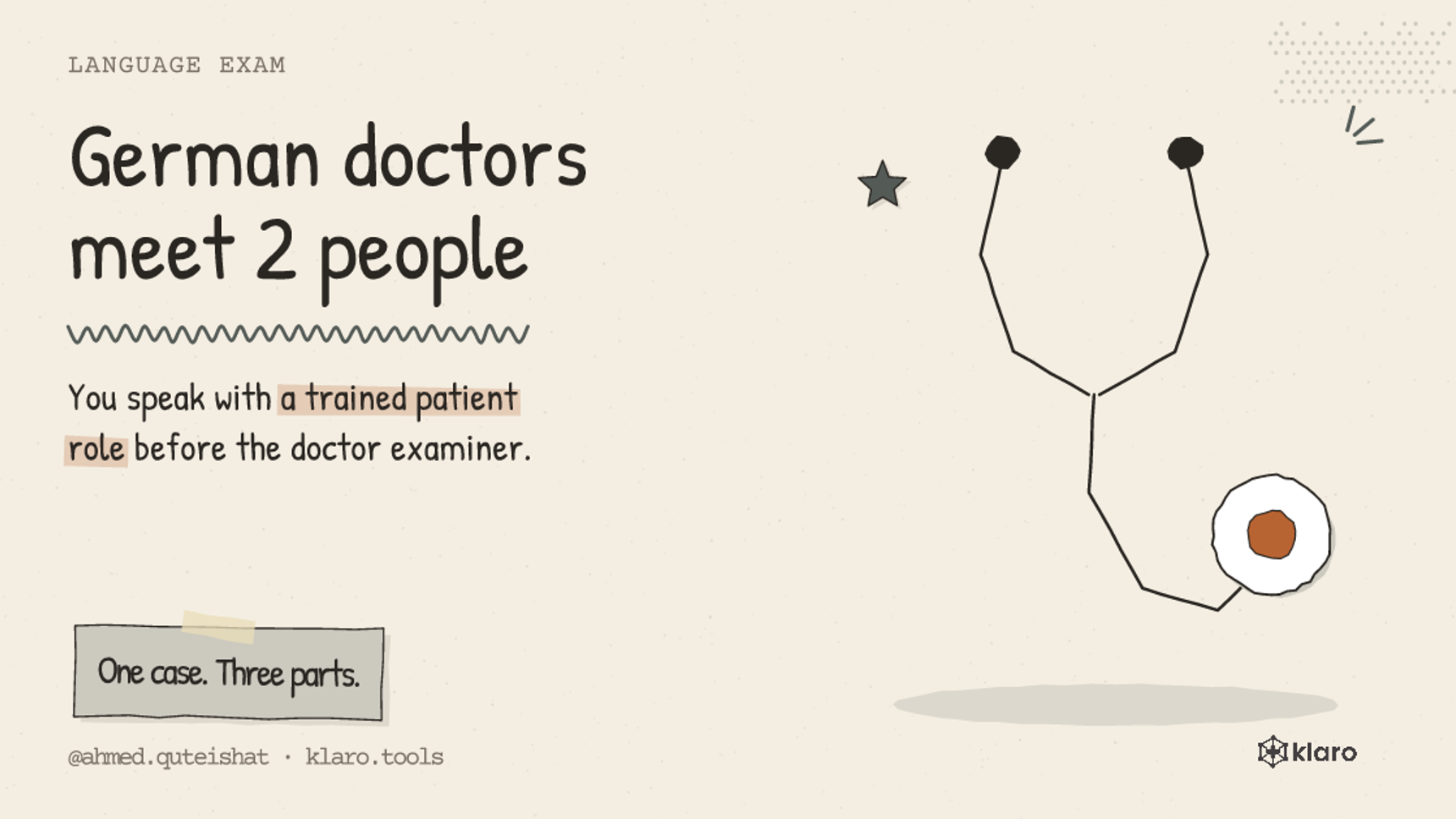
In Germany’s medical language exam, you work through one clinical case with different people. You speak to a trained patient role, write a report, then hand over to a doctor examiner.
The exam tests German for hospital work. It does not test rare medical knowledge.
Who plays the patient?
The patient is usually a trained simulated patient. This person follows a written case, such as chest pain, dizziness, or abdominal pain.
They give details when you ask clear questions. A patient with chest pain may mention smoking, medicines, or pain after walking.
Treat this person like a patient in an emergency room or clinic. Introduce yourself and explain why you are asking each question.
Ask about symptoms, medicines, allergies, past illness, and family history. Use simple German words before medical terms.
Do not guess the diagnosis after 2 questions. A rushed list of questions sounds unnatural in the consultation.
Who is in the room?
The state medical chamber runs the exam. Small details differ by state.
In the standard 3-part exam, examiners listen to your language during the case. One examiner takes the doctor role during the final handover.
You do not need rare diagnoses to impress the examiner. You need a handover that another doctor understands quickly.
Say the patient’s name, main complaint, history, findings, and next steps. Picture a senior doctor reading your notes before morning rounds.
What happens in each part?
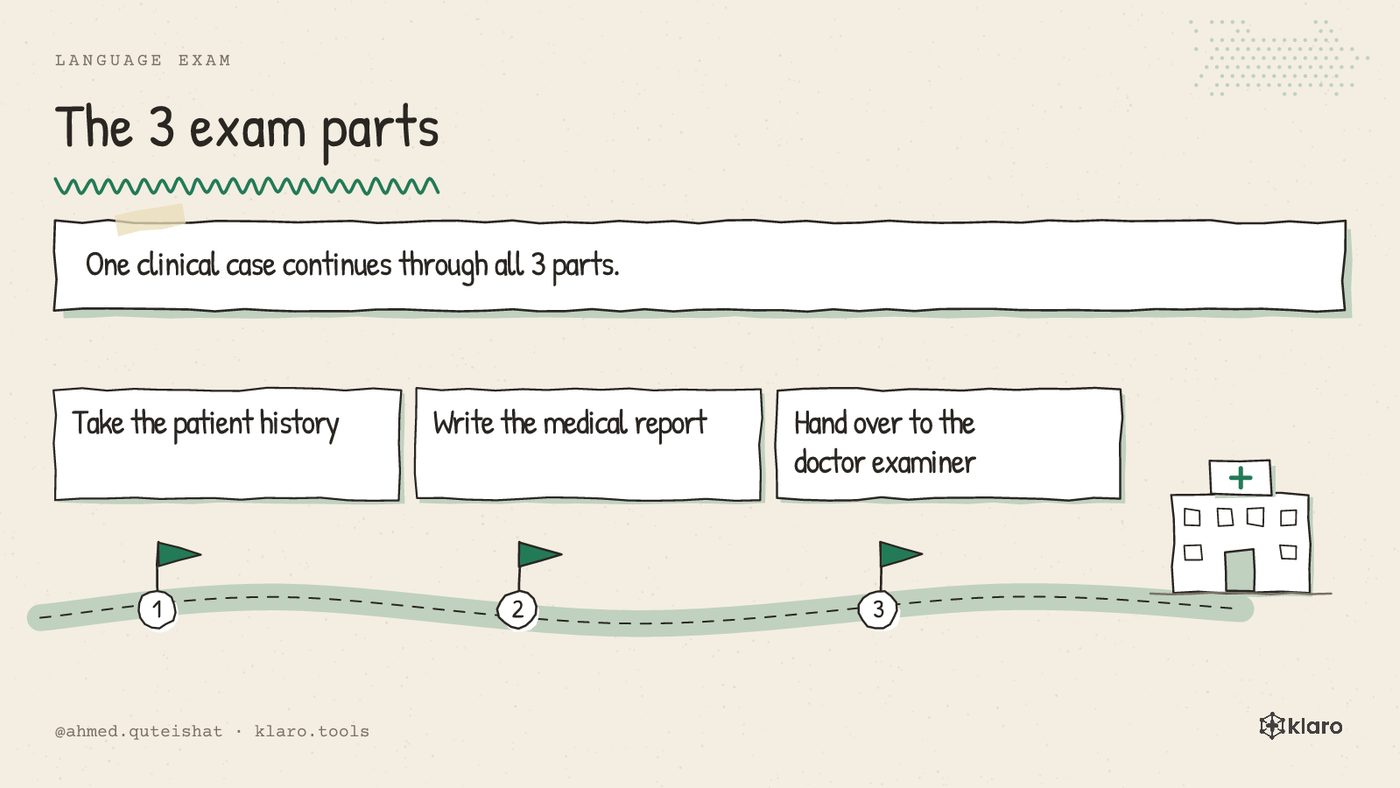
The medical language exam is one 60-minute exam with 3 parts of about 20 minutes each, as of October 2026. You stay with the same clinical case from start to finish.
- Patient interview: You take a history from the simulated patient.
- Written report: You write a short German medical report from your notes.
- Doctor handover: You present the case to a doctor examiner and answer questions.
Your notes connect all 3 parts. Write down symptoms, time course, medicines, allergies, operations, and important negative answers.
Keep the paper beside you during the report. Use the same details during the handover.
What examiners listen for
Examiners listen for understandable German, correct medical words, and a clear order. They also listen to how you explain tests and treatment to the patient.
For example, explain a blood test, ultrasound, or hospital admission in simple words. Then use the medical term when you speak to the doctor examiner.
- Start with an open question: “What brings you here today?”
- Ask one topic at a time, then listen to the answer.
- Use patient words first, then name the medical term.
- Finish with a short summary before your report.
What to do before exam day
Practise one full case with a study partner. One person plays the patient and one person listens like the doctor examiner.
Change roles after each case. Use a timer, paper notes, and a blank report sheet.
- Print a blank report sheet and write one report in 20 minutes.
- Record a 2-minute handover for chest pain or abdominal pain.
- Ask your state medical chamber which exam format applies in your state.
- Learn German phrases for medicines, allergies, operations, and smoking.
Stand: 2026-10-17. This is a guide, not legal advice. Every German state has its own rules, and rules change. Check with your state's [medical chamber (Landesärztekammer)](https://www.bundesaerztekammer.de/aerztekammern) before you act.
Ahmed Quteishat — Founder, Klaro
Ahmed built Klaro after watching how much of a doctor's move to Germany gets lost in paperwork rather than medicine.