MKG Surgery in Germany Requires Two Degrees Before Training
MKG surgery in Germany requires a medical degree and a dental degree. Foreign doctors need recognition for both licences before specialist training starts.
Ahmed Quteishat
Founder, Klaro
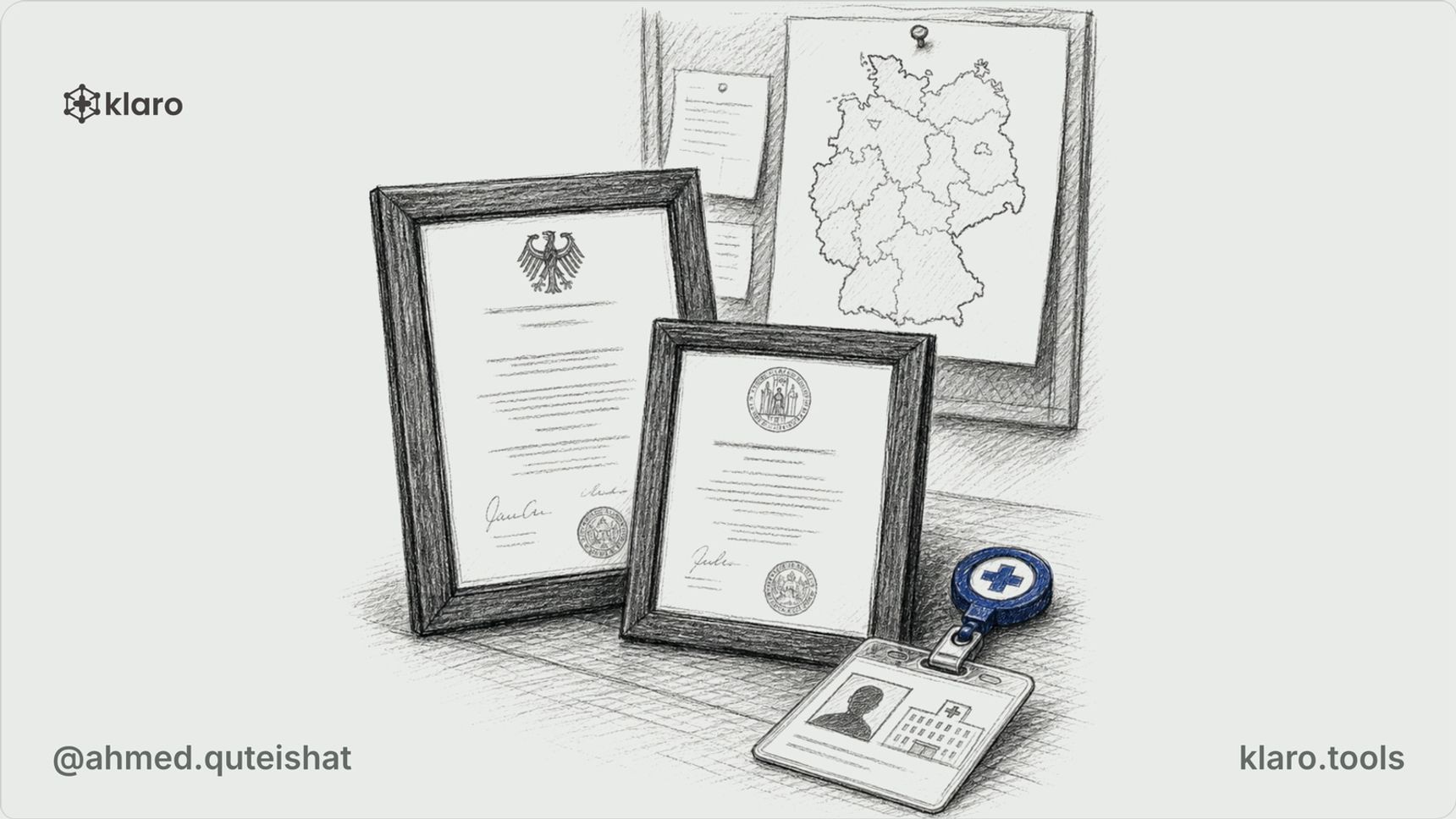
MKG surgery in Germany requires both a medical degree and a dental degree before you can start specialist training. A medical Approbation alone does not open an MKG-Chirurgie post. The department needs a doctor who also holds a German dental licence, called a zahnärztliche Approbation.
This is the detail many foreign doctors miss when they see an attractive job in a university hospital in Berlin, Munich, or Heidelberg. You may already have passed the Fachsprachprüfung, received your medical Approbation, and worked as an Assistenzarzt. For MKG-Chirurgie, the dental licence is still a separate requirement.
Why does MKG-Chirurgie need 2 degrees?
Mund-Kiefer-Gesichtschirurgie, or MKG-Chirurgie, is oral, jaw, and facial surgery. The specialty covers facial trauma, jaw surgery, facial tumours, cleft surgery, dental implants, and operations around the mouth. German training rules require doctors in this specialty to hold both medical and dental qualifications.
That rule reflects the daily work in an MKG department. In one operating list, a junior doctor may assist with a mandibular fracture after a bicycle crash. Later, the same team may place implants, remove impacted teeth, or plan a jaw correction with orthodontists. Germany treats that mix of facial surgery and dentistry as one specialty.
The model is different from many countries. In Egypt, India, Pakistan, Syria, Iran, Turkey, Jordan, and Nigeria, maxillofacial surgery may be entered through medicine alone, dentistry alone, or a local combined route. German chambers do not replace the second degree because you performed facial operations abroad.
What does this mean for a foreign medical graduate?
It means a foreign medical graduate with only an MD should not apply for MKG specialist training as the next step. First, you need a recognised dental degree and a German dental licence. Your medical Approbation allows medical work, but it does not allow you to enter the MKG Weiterbildung.
The licensing authority in your Bundesland decides the dental application. In Berlin, this is handled through the state health authority. In Bavaria, the responsible government office handles recognition. The office compares your dental diploma, transcript, internship papers, passport, language certificates, and certificates of good standing with German dental training.
If the office finds major differences, it can require a dental knowledge exam or an adaptation period before issuing the dental licence. The exact papers, fees, and exam arrangements differ by Bundesland. The Recognition in Germany portal lists the authority for each state and the current application route.
Does your foreign dental degree solve the problem?
Yes, a completed foreign dental degree gives you a possible route into MKG-Chirurgie in Germany. It does not give you an automatic German dental licence. The licensing authority checks the diploma and your dental training separately from your medical licence.
A doctor with an MBBS and a BDS has a realistic starting point. They submit 2 recognition files, one for medicine and one for dentistry, then apply to MKG departments after both licences are issued. A doctor with only an MBBS needs to obtain a full dental qualification first, which is a major career decision rather than a short administrative step.
Your foreign job title also matters less than your diplomas at this stage. A certificate saying you worked in maxillofacial surgery in Cairo, Lahore, Tehran, or Damascus helps a chief understand your experience. It does not replace the dental degree named in the German specialty rules.
How long is MKG specialist training in Germany?
The model training rules of the German Medical Association list 60 months of MKG-Chirurgie training after both licences are in place. Your state medical chamber, called the Landesärztekammer, issues the final specialist rules and checks your Logbuch, the training record with operations and clinical work.
The department also needs a senior doctor with a training licence, called the Weiterbildungsbefugnis. That person signs your Logbuch. A university clinic may offer complex tumour surgery and free-flap reconstruction, while a smaller hospital may offer only part of the required training period.
Foreign surgical years can be submitted to the Landesärztekammer for credit. The chamber normally compares your operation lists, employment certificates, rota, and supervisor letters with its training catalogue. It may credit parts of facial trauma or ward work, but the chamber does not use foreign years to remove the requirement for 2 German licences.
Is MKG-Chirurgie a practical first choice?
For a doctor who already holds both degrees, yes, MKG-Chirurgie is a direct specialty target. Apply with 2 licences, a German CV, operation lists, and a clear explanation of your facial surgery experience. Departments will understand immediately that you meet the basic entry rule.
For a doctor with medicine only, choose another surgical specialty if you want to start work in Germany soon. General surgery, ENT, plastic surgery, neurosurgery, and ophthalmology each have their own entry rules, but they do not require a dental licence for medical specialist training. Your medical Approbation can lead to an Assistenzarzt job in those departments.
Do not spend months sending MKG applications with only a medical licence. The chief cannot appoint you into the specialist programme without the dental qualification. Put your time into a dental recognition file if you already hold the degree, or choose a specialty that matches the degree on your diploma.
What to do before you apply
- Put your medical diploma and dental diploma side by side. If you do not have a completed dental degree, remove MKG-Chirurgie from your immediate job list.
- Use the Recognition in Germany portal to find the dental licensing authority in your Bundesland.
- Ask the licensing authority in writing: "Which papers do you require for recognition of my foreign dental degree and a zahnärztliche Approbation?"
- Ask an MKG department: "I hold medical and dental licences. How many months of MKG training can your senior doctor certify in my Logbuch?"
- Send your operation list, employment certificates, and supervisor letters to the Landesärztekammer before you count foreign facial surgery years toward Facharzt training.
Stand: 2026-09-14. This article is orientation, not legal advice. Rules differ by Bundesland and change — always confirm with your [Landesärztekammer](https://www.bundesaerztekammer.de/aerztekammern) before acting.
Ahmed Quteishat — Founder, Klaro
Ahmed built Klaro after watching how much of a doctor's move to Germany gets lost in paperwork rather than medicine.