German cardiology has no separate fellowship
Germany has no separate interventional cardiology fellowship. Finish cardiology training, get cath-lab cases, then build toward a DGK qualification.
Ahmed Quteishat
Founder, Klaro
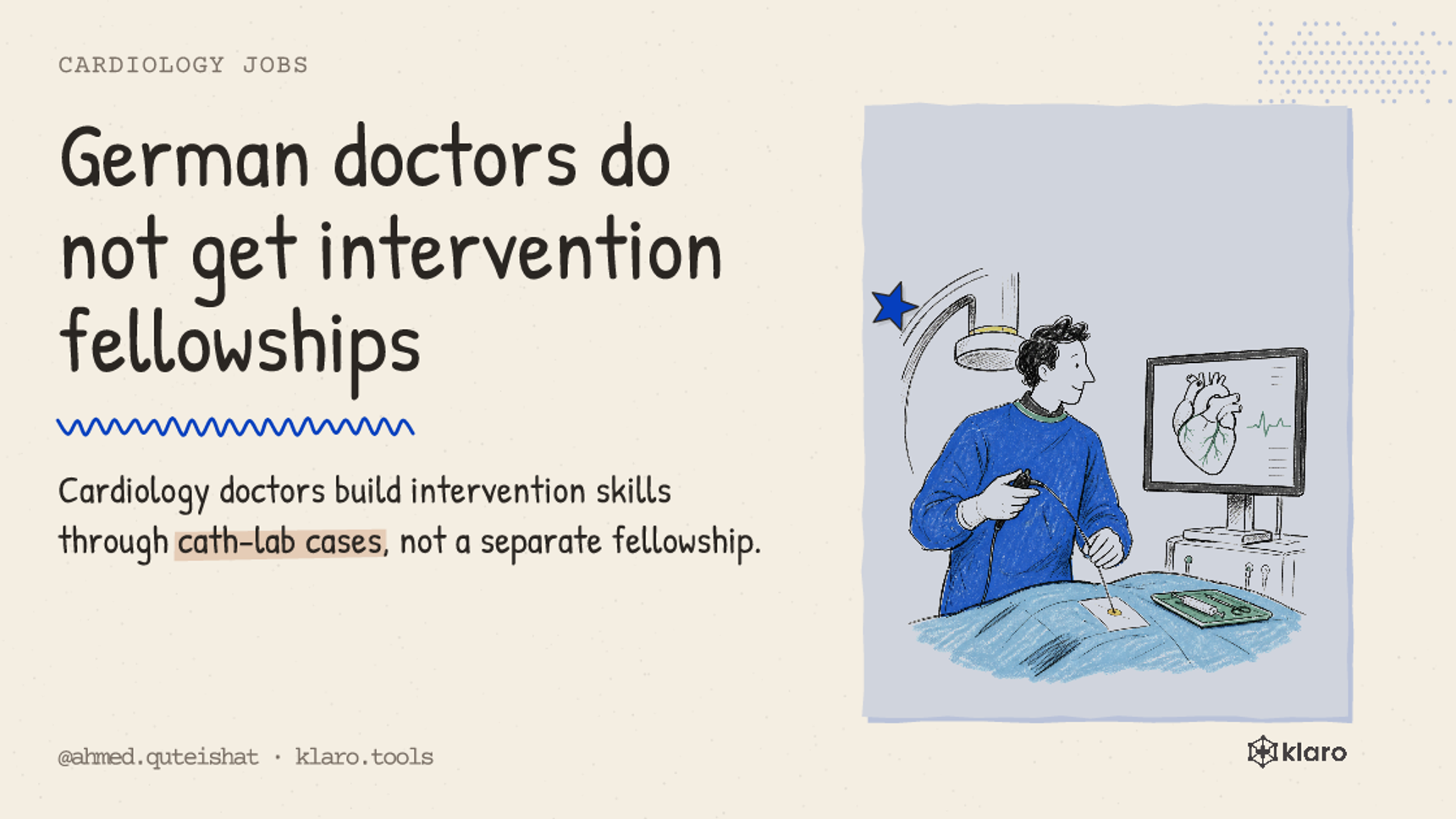
Germany has no separate fellowship for interventional cardiology. You first become a specialist in internal medicine and cardiology (Facharzt für Innere Medizin und Kardiologie). Then you build cath-lab experience in a hospital.
This matters before you apply for your first German junior doctor job. A cardiology department without a cath lab will not give you coronary angiography lists, PCI cases, or intervention supervisors.
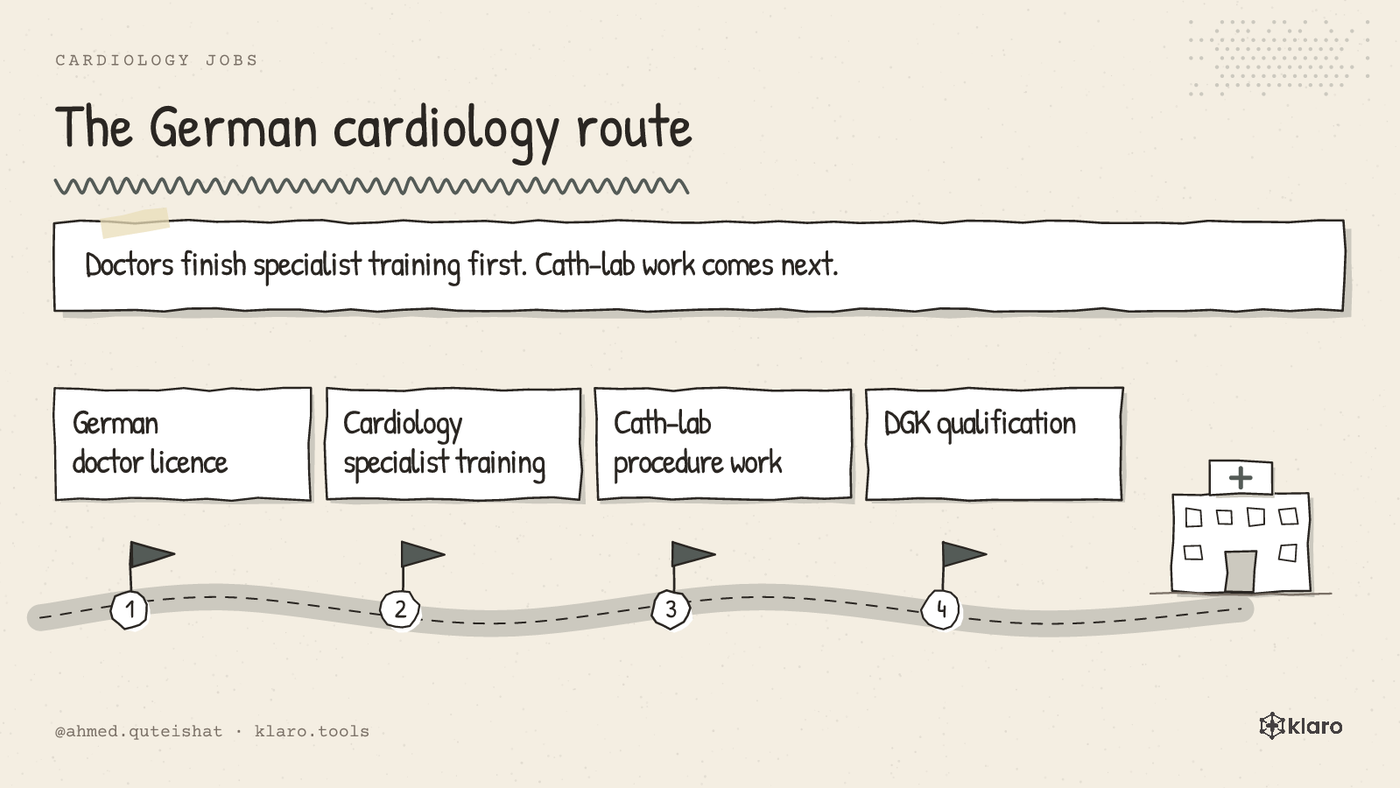
The German route in plain words
Your state medical chamber sets the specialist training rules. The training record lists cardiology work, procedures, rotations, and sign-offs from your training supervisor.
- Get your full doctor licence (Approbation) and a junior doctor job in Germany.
- Finish specialist training in internal medicine and cardiology.
- Work in a department with an active cardiac catheter laboratory.
- Collect supervised angiography and intervention work for later applications.
- Apply for intervention-heavy senior training posts and DGK recognition.
The German Cardiac Society, called DGK, offers qualifications in interventional cardiology. This is a professional qualification. It is different from your state medical chamber specialist certificate.
The cath lab decides your future
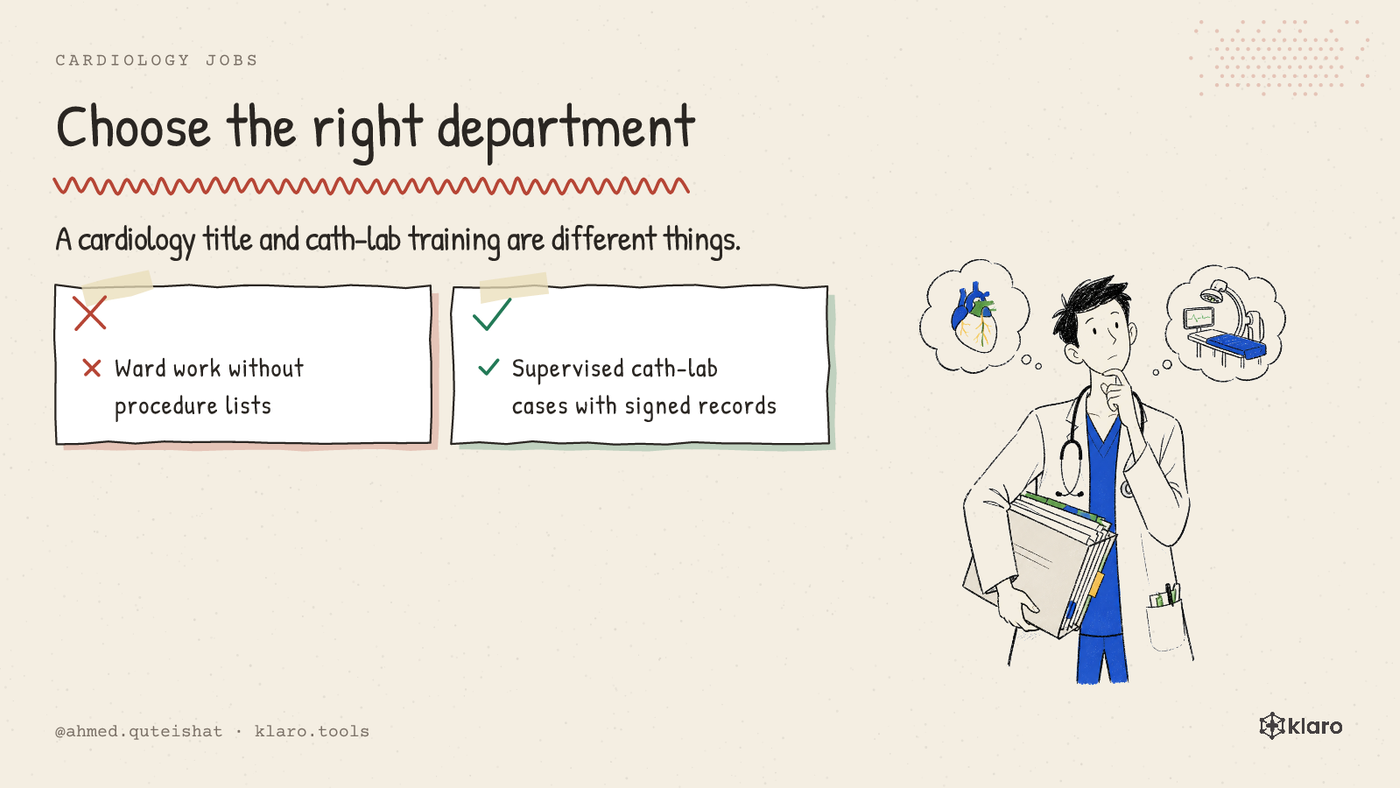
The hospital department decides whether you touch the catheter table. Your specialist title alone does not give you PCI experience.
In a strong interventional unit, you start with ward patients, emergency admissions, echo, and consent talks. Afterwards, you assist in the cath lab and build case numbers under named senior doctors.
A small cardiology department may give you more hands-on work. A university hospital may have complex structural cases, but many fellows compete for the same lists.
What DGK recognition changes
DGK qualifications give departments a clear way to read your cath-lab experience. They look for named procedure work, supervisors, and certificates from your department.
A CV line saying “interested in intervention” is weak. A case list signed by a cath-lab lead, with coronary angiographies and PCI participation, gives a chief something concrete to read.
- Keep a dated procedure list from your first cath-lab month.
- Save rotation certificates and signed training record pages.
- Ask each cath-lab lead which cases you may record.
- Read the current DGK rules before paying for courses.
Getting an intervention-heavy post
You get intervention-heavy posts through department choice, not after a separate national match. Chiefs hire doctors who already know German ward work and can show supervised cath-lab time.
Your first job does not need to be a famous heart centre. It needs a real cath lab, a named supervisor, and a written answer about your time on the procedure list.
What to do before signing
- Ask the chief: “How many cath-lab days does a junior doctor get each month?”
- Ask for the name of the doctor supervising coronary procedures.
- Add every supervised angiography and PCI task to your procedure list.
- Read the DGK qualification rules for interventional cardiology before changing hospitals.
Stand: 2026-10-12. This is a guide, not legal advice. Every German state has its own rules, and rules change. Check with your state's [medical chamber (Landesärztekammer)](https://www.bundesaerztekammer.de/aerztekammern) before you act.
Ahmed Quteishat — Founder, Klaro
Ahmed built Klaro after watching how much of a doctor's move to Germany gets lost in paperwork rather than medicine.