€10,506 in One Month: How to Pick a Hospital That Actually Pays for Your Shifts
Two first-year doctors on the same tariff can take home very different money. The difference isn't the salary table — it's how your hospital settles Dienste. Here's what to check before you sign.
Ahmed Quteishat
Founder, Klaro

Every salary guide for doctors in Germany does the same thing. It prints the tariff table, points at the row for your Entgeltgruppe, and stops. First year, municipal hospital, somewhere around €5,600 gross a month.
That number is correct, and it is nowhere near the whole story. In one month of my first year I earned €10,506.60 gross. The base salary on that payslip was €5,609.85. The other €4,896.75 was thirteen Dienste (duties) — and the only reason it showed up as money is that my hospital pays them out.
At a hospital twenty minutes away, those same thirteen duties could have come back as days off instead, and the payslip would have read €5,609.85. Same tariff, same work, a completely different number at the bottom.
That difference isn't luck, and it isn't negotiating skill. It is a handful of things you can check before you sign — and most of them are written down in the tariff.
The short answer
- Does the hospital pay Dienste out, or give time off? The single biggest lever, and the one nobody asks about in an interview.
- Which Bereitschaftsdienststufe your contract puts you in. It decides whether an hour of on-call counts as 70%, 85% or 100% of an hour worked.
- Whether your "Dienst" is Bereitschaftsdienst, Rufbereitschaft or Schichtdienst. Three different things, three completely different rates.
- How long a duty runs — 24, 12 or 8 hours changes how many paid hours you accumulate.
- How many duties you're actually allowed. Four a month is the tariff norm, not the ceiling most people assume.
- Which tariff the hospital is on at all — municipal, university, or a private house contract.
Everything below is the detail behind those six.
Where the €10,506 actually came from
Six lines, and none of them are mysterious:
- Entgelt — the base salary — €5,609.85
- Bereitschaftsdienstvergütung — 73.50 valued hours at €36.14 — €2,656.29
- Nachtstunden Bereitschaftsdienst — 146.25 night hours at €5.42 — €792.68
- Bereitschaftsdienstzuschlag 15% — 17.85 hours at €5.42 — €96.75
- Zuschlag für mehr als vier Dienste — 12.48 hours at €36.14 — €451.03
- Bereitschaftsdienst (pauschal) — a flat local payment — €900.00
The €36.14 is not a number my hospital invented. It is the TV-Ärzte/VKA hourly rate for Entgeltgruppe I, Stufe 1, in force from 1 August 2025 — it is printed in the tariff. The €5.42 is exactly 15% of it, which is the surcharge the tariff attaches to on-call hours. Across thirteen duties, 146.25 night hours works out at 11.25 hours of night per duty.
One line is worth understanding properly: that €792.68 of night pay was tax-free. Under § 3b EStG, night premiums are exempt up to 25% of your hourly base pay, so the tax office calculated on €9,713.92 rather than the full €10,506.60. After tax and social insurance the statutory net was €8,023.89; after the Zusatzversorgung and the Ärzteversorgung (the doctors' own pension fund — €748.65 in that month alone), €7,212.10 reached my account.
Roughly a third of the gross went somewhere else. That is normal, and it is the part the salary tables never show you.
Freizeitausgleich or money — ask this first
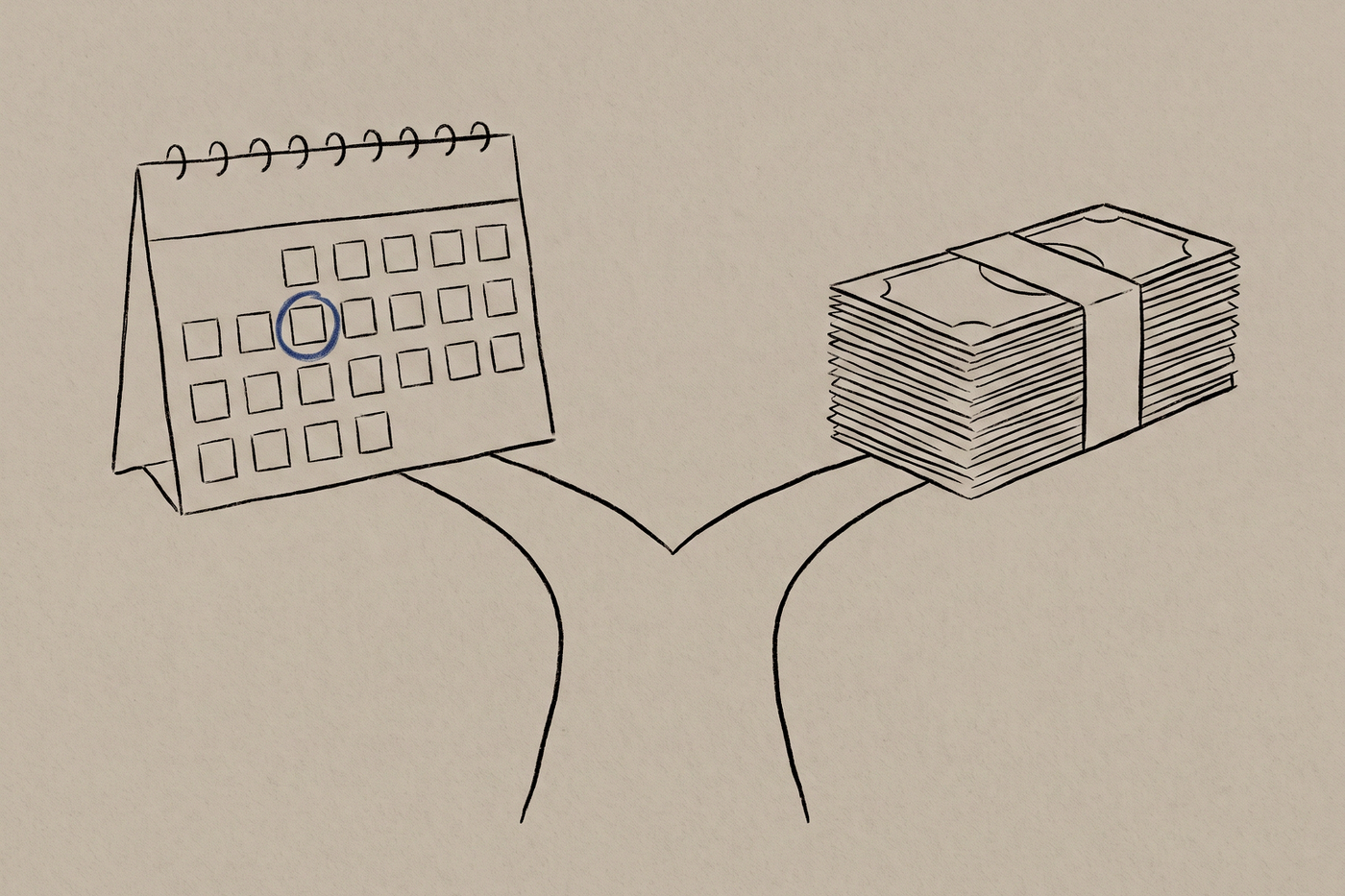
Freizeitausgleich is time off in lieu, and it is the reason two doctors doing identical work end up with different payslips.
Under TV-Ärzte/VKA the rule is narrower than most people assume. Time off may replace payment for the purpose of granting your statutory rest period, to the extent required. Going beyond that — settling whole duties in days off rather than money — is only allowed "im Einvernehmen mit der Ärztin/dem Arzt": in agreement with you. During the time off, your normal salary keeps running.
Two things stay money regardless of what your department prefers. The tariff says the 15% on-call surcharge and the 15% night surcharge "kann nicht in Freizeit abgegolten werden" — cannot be settled in free time. Even at a hospital that compensates everything else in days, those two lines have to be paid.
None of this makes Freizeitausgleich the worse deal. If you're exhausted, days off are worth more than the money, and plenty of doctors choose them deliberately. The problem is only ever discovering the arrangement after you've signed.
What to actually ask: are Bereitschaftsdienste paid out or compensated in time — and is that in the contract, or is it a habit on that particular Station?
What your duty is actually called
The word "Dienst" covers three legally different things, and the label decides the arithmetic.
- Bereitschaftsdienst — you stay somewhere the employer specifies, ready to work. The employer may only order it where the time without work is expected to predominate. Paid per valued hour, plus surcharges.
- Rufbereitschaft — you stay somewhere you've told the employer, reachable by phone, and it may only be ordered where work arises in exceptional cases. Paid as a daily flat rate: two hours' pay Monday to Friday, four hours' on a Saturday, Sunday or holiday. Each call-out is then rounded up to a full hour and paid as overtime.
- Schichtdienst — ordinary shift work. Every hour is a full hour, and there is a monthly Schichtzulage on top (€210, rising to €315 from January 2026).
A rota full of Rufbereitschaft looks similar to one full of Bereitschaftsdienst and pays very differently.
The Stufe hidden in your contract
Bereitschaftsdienst is not paid hour for hour. It is valued according to how much work typically happens during it:
- Stufe I — up to 25% of the time is actual work — 70% of the hours count
- Stufe II — more than 25% up to 40% — 85% count
- Stufe III — more than 40% up to 49% — 100% count
Your Stufe is a Nebenabrede — a side agreement to your contract — and it can be terminated with three months' notice to the end of a half-year. If your nights are genuinely busier than the Stufe assumes, that is a conversation you're entitled to have, not a fixed property of the job.
24, 12 or 8 hours — what the model does to your month
A 24-hour duty is legal under the tariff where the portion beyond eight hours is Bereitschaftsdienst, and it has to follow a regular working segment of at most eight hours. Weekend and holiday duties may run to 24 hours specifically where that gives you more free weekends. Fewer duties, more valued hours in each one.
A 12- or 8-hour shift model is the opposite trade. Every hour is a full working hour with the shift allowance on top, but there is no on-call valuation and none of the on-call surcharges — so the ceiling is lower and the floor is higher.
Neither is better. They pay differently, and which suits you depends on whether you want predictability or headroom.
Your weekly limit sits underneath all of it: 48 hours on average normally, up to 56 if you sign the opt-out, and up to 66 only where a state-level agreement allows it in justified cases. The average is calculated over six months, which is why a brutal month can be legal as long as a quiet one follows.
How many Dienste you're even allowed
This is where a €10,506 month stops looking like something you can plan for.
The tariff norm is four Bereitschaftsdienste per calendar month. One month per quarter may go to five. Anything beyond that is only required "if patient safety would otherwise be endangered" — it is an emergency clause, not a business model.
So thirteen duties in a month is not a normal month. It is what happens when a department is badly short-staffed and you volunteer for everything open, which is exactly what I did. The tariff prices that: from the fifth duty the valuation rises by 10 percentage points, and by a further 10 for every additional duty. That escalation is the "more than four Dienste" line on my payslip, and it is a large part of why the number got that high.
Rufbereitschaft has its own ceiling of 13 a month, and there are rules limiting how many of each you can be given in combination.
One more thing worth money: the Dienstplan has to be published a month before the period it covers. If it isn't — or if a change lands less than three days before a duty — the on-call valuation goes up by 17.5 percentage points. A department with chronically late rotas is telling you something about how it's run, and owes you for it.
What to actually ask before you sign
- Are Bereitschaftsdienste paid out or settled in time off — and where is that written down?
- Which Bereitschaftsdienststufe does my contract put me in, and when was it last reviewed?
- Is what you're calling a "Dienst" Bereitschaftsdienst, Rufbereitschaft, or a shift?
- How long is one duty, and how many will I realistically do in a normal month?
- Am I expected to sign the opt-out, and what happens to the rota if I don't?
- When does the Dienstplan actually come out?
- Which tariff applies — TV-Ärzte/VKA at municipal hospitals, TV-Ärzte/TdL at university hospitals, or a private chain's house contract? The weekly hours differ: VKA is usually 40, TdL 42.
- Is there anything paid on top of the tariff? My payslip carries a €900 flat on-call payment that is a local arrangement, not a tariff line — those exist, and they are never advertised.
Ask these of a current resident on the ward, not only of HR or the Chefarzt in an interview. The tariff tells you what is possible. Only someone already doing the rota can tell you what actually happens.
So — was €10,506 a normal month? No. A normal month on that contract was the €5,609.85 base. But the ceiling was real, it was reachable inside the rules, and whether you can reach it at all is mostly decided on the day you sign, not the day you start.
This is general information about how TV-Ärzte/VKA and German working-time rules apply to employed doctors, not personalised legal or financial advice. Tariff terms change, university and private-chain contracts differ, and individual hospitals add local arrangements on top. My own figures are one payslip from one month at one municipal hospital — treat them as a worked example, not a benchmark. Check your own contract and Nebenabreden, and the current tariff text, before making a decision.
If you're weighing up actual openings rather than the theory — Klaro's job board is the same place we point people from the video.
Ahmed Quteishat — Founder, Klaro
Ahmed built Klaro after watching how much of a doctor's move to Germany gets lost in paperwork rather than medicine.