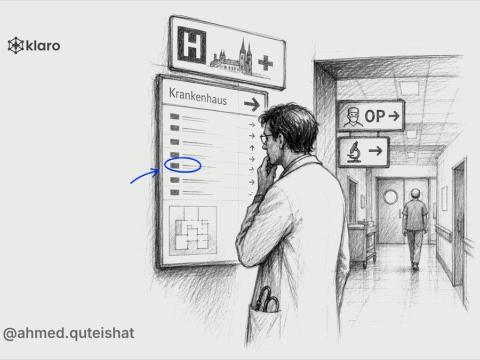
Do Foreign Surgeons Get Fewer Operating Cases in German Hospitals?
Foreign surgeons lose cases when senior doctors allocate theatre work informally. Ask for a named supervisor, Logbuch review, and written case plan before signing.
Ahmed Quteishat
Founder, Klaro
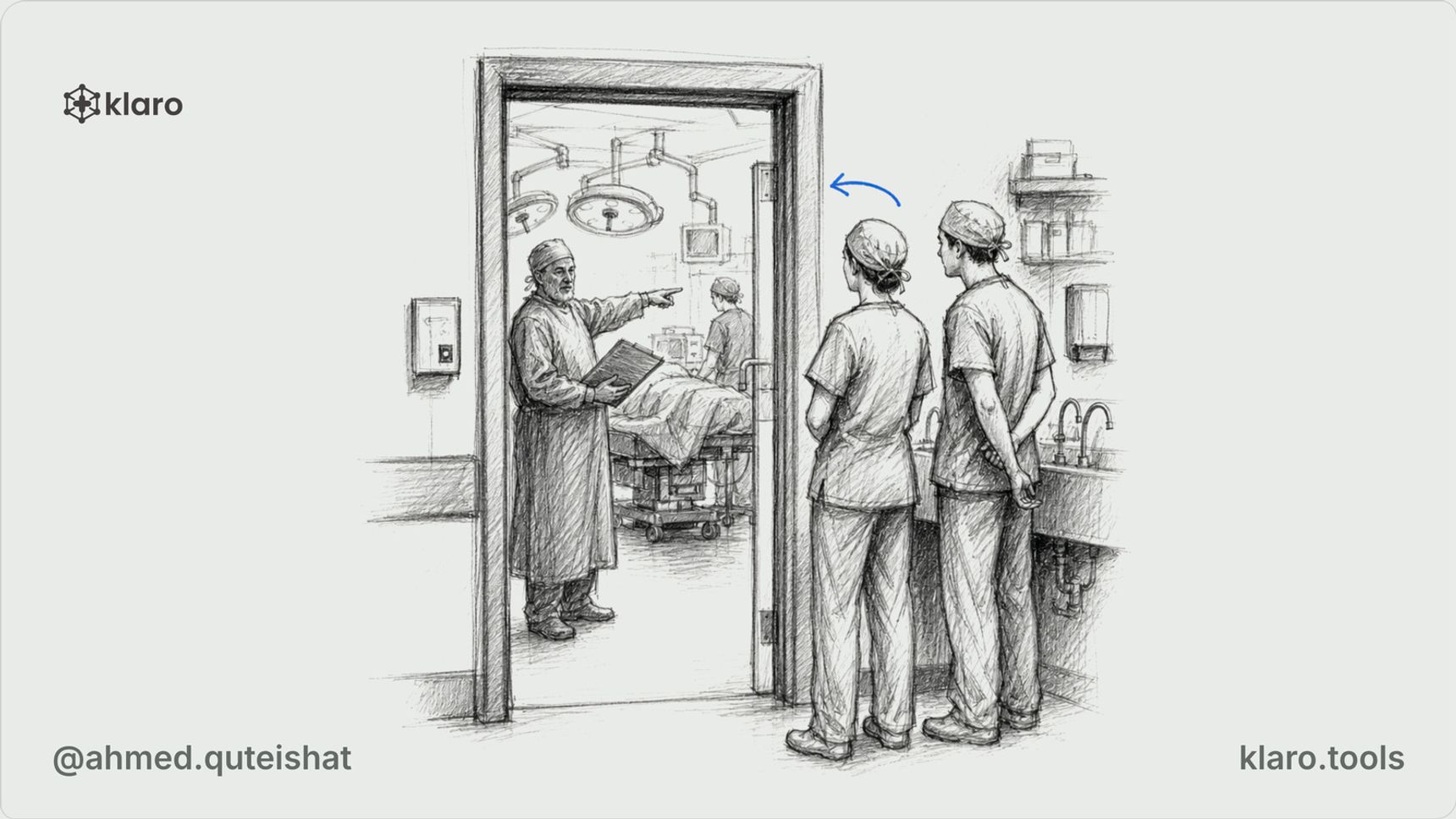
Foreign surgeons get fewer operating cases in Germany when a department leaves the operating list to informal senior-doctor trust. The answer is not to wait quietly for your turn. Before you sign a contract, ask who will watch you operate, which procedures you will do in year 1, and when your Logbuch is reviewed.
The search phrase ausländische Chirurgen Fallzahlen Klinik describes a real fear: you arrive with an Approbation, stand at the operating table, and spend months holding suction while another resident closes skin. But German training rules do not give a senior doctor permission to reserve cases for German nationals. The problem is that many surgical departments do not publish a fair internal list for appendectomies, hernias, central lines, or laparoscopic cholecystectomies.
Who actually gives you an operating case?
The senior doctor running that operating room decides who performs the next step. At 7:15am, they look at the patient, the planned procedure, the anaesthetics schedule, and the residents already standing scrubbed in. They choose the person whose hands, German communication, and previous work they know.
That daily decision is local. The chief surgeon sets the department culture. The senior doctor controls the list that morning. The doctor with the training licence, called the Weiterbildungsbefugnis, later signs your training record. In a well-run department, these 3 people use the Logbuch and a rotation list. In a weak department, cases go to the resident who is already known to the consultant.
A new resident loses in that system, whether they trained in Damascus, Delhi, Cairo, or Cologne. Foreign surgeons face the problem more sharply because they often start with a new language, no German senior doctor who has seen them operate, and a contract after several months outside the theatre. That is an access problem inside one department. It is not a national German rule.
Does German training law set a nationality quota?
No. The Muster-Weiterbildungsordnung, the model specialist-training rules from the German Medical Association, sets skills and procedure requirements for each specialty. It does not set one quota for German residents and another for international residents. Your state medical chamber adopts its own training rules and checks whether your signed Logbuch covers the required work.
For General Surgery, the Logbuch contains operations and clinical tasks that must be signed during your years as a junior doctor. Plastic Surgery, Orthopaedics and Trauma Surgery, and Visceral Surgery have their own training requirements. A ward full of discharge letters and blood draws does not replace missing operations in the Logbuch.
The important exception is patient safety. A senior doctor can stop a resident from operating independently after an unsafe step, poor sterile technique, or a communication failure in the pre-operative briefing. That decision should lead to supervision, feedback, and another observed case. It should not become a permanent sentence with no written feedback.
Where the bias claim becomes believable
The claim becomes believable when the same pattern repeats on paper. You have completed the department induction, worked on-call shifts, attended the operating list, and asked to perform defined steps. Yet after 6 months your Logbuch still has few signed procedures while one colleague receives the same cases every week.
Look for concrete differences. Is one resident assigned to the hernia list every Tuesday? Does a senior doctor ask only certain residents to scrub for emergency laparotomies? Are you sent to admissions while another junior doctor enters theatre? A notebook with dates, procedure names, consultant names, and your role shows a pattern better than a general complaint.
Language matters at the start, but it is not a permanent explanation. In the operating room you must understand the surgeon, scrub nurse, anaesthetist, and the safety briefing. After you can present the patient, explain the planned operation, and answer instructions clearly, the department should give you observed operative steps rather than leave you on ward work indefinitely.
What a good surgical department does differently
A good department puts the learning schedule in front of you. In the first meeting, the senior doctor names the procedures for your first months: wound revision, abscess drainage, appendectomy steps, camera work, closure, and emergency room procedures. The list reflects the specialty and the hospital, but it gives you a visible starting point.
The department also has regular Logbuch meetings. A supervisor opens your Logbuch, compares signed procedures with the specialty rules, and gives you the next task. If you need more laparoscopic exposure, they put you on a suitable operating list. If you need ward experience first, they say how long and what skill you must show.
Do not accept vague promises such as “everyone gets cases.” Ask for the number of months the hospital can certify under its training licence. Then ask which consultant supervises your first operations. A hospital that cannot name a person, a procedure, or a review date is telling you that theatre training is not organised.
What to do when your Logbuch stays empty
Start with one calm meeting, not a corridor argument after a long shift. Bring your Logbuch and a one-page list of the operations you attended, the steps you performed, and the dates. Ask the supervising senior doctor for 2 defined procedures or operative steps during the next rotation.
If nothing changes, email the doctor holding the training licence. State the missing procedure areas and ask for a meeting with a written learning schedule. Keep the email, the rota, and your Logbuch entries. These documents matter if you later ask the state medical chamber whether a period of training can be certified.
Discrimination based on racial or ethnic origin is prohibited in employment under Germany's General Equal Treatment Act. If comments, exclusions, or case allocation target your origin rather than your work, speak to the hospital works council, the staff representative body, or an employment lawyer. A complaint is stronger when it names a date, operating room, procedure, person, and witness.
What to do on Monday
- Ask the chief or senior doctor: “Which operations or operative steps will I perform in my first 6 months as a junior surgeon?”
- Ask the doctor with the training licence: “How many months of specialist training can this department certify, and when do we review my Logbuch?”
- Write down every operating list you attend, including the procedure, your operative step, the senior doctor, and whether it was signed.
- Email the training licence holder if you have repeated ward-only weeks and missing Logbuch procedures. Ask for 2 named operative goals for the next rotation.
Stand: 2026-09-22. This article is orientation, not legal advice. Rules differ by Bundesland and change — always confirm with your [Landesärztekammer](https://www.bundesaerztekammer.de/aerztekammern) before acting.
Ahmed Quteishat — Founder, Klaro
Ahmed built Klaro after watching how much of a doctor's move to Germany gets lost in paperwork rather than medicine.