Why German Hospitals Reject IMG Facharzt Applications
A Facharzt Bewerbung is rejected when it does not answer the department’s immediate need: licence, German ward work, duty cover, specialty fit, and a clear start date.
Ahmed Quteishat
Founder, Klaro
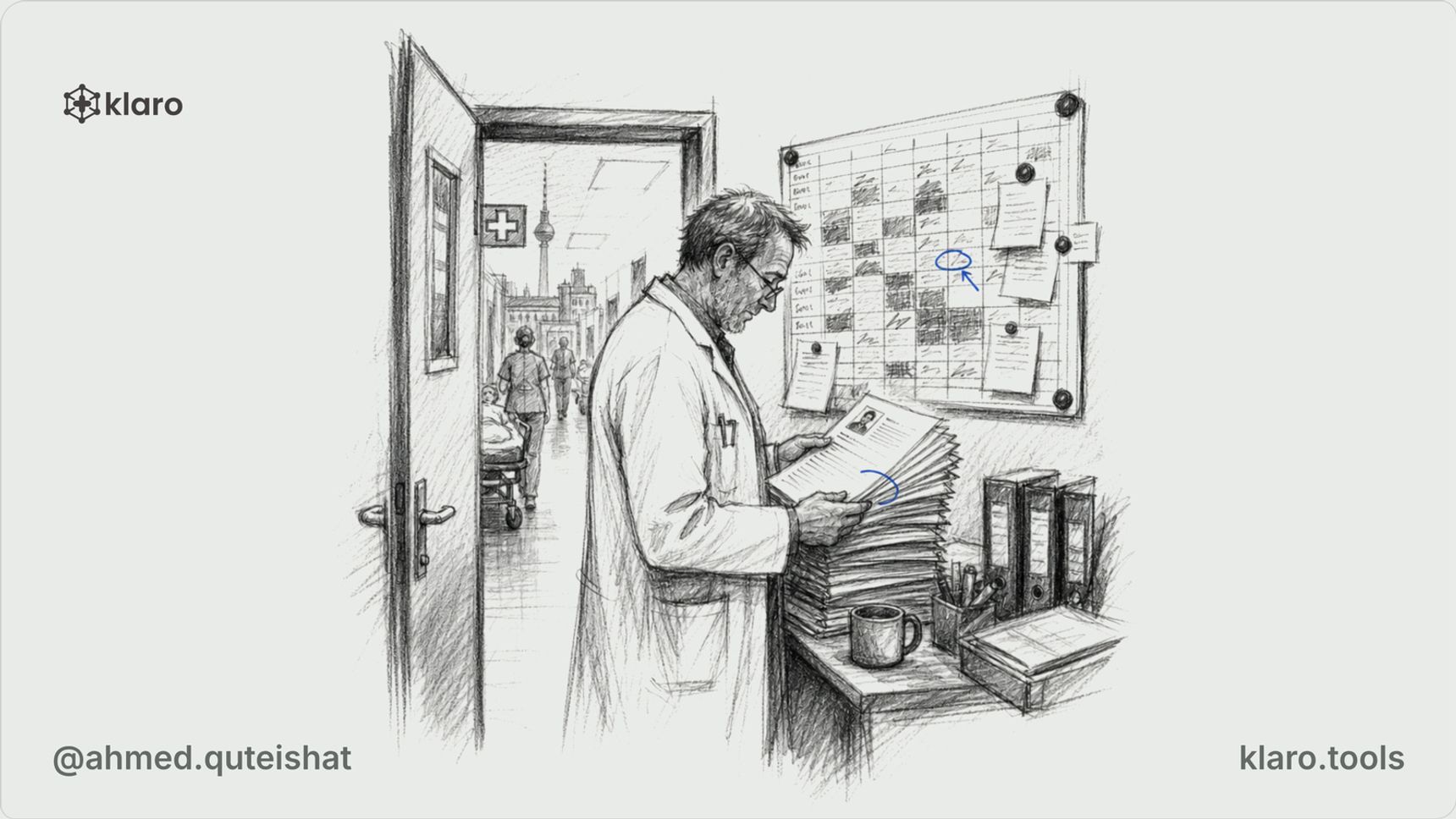
German hospitals reject IMG doctors when the application does not show they can fill the department’s next ward and duty gap. A chief opening 20 applications for an Assistenzarzt job does not begin with your diploma. They look for a licence status, German ward experience, a start date, and someone who can join the Dienstplan without creating extra work for the senior doctors.
This is why a Facharzt Bewerbung can be rejected even when every certificate is attached. Facharzt means specialist in Germany, but most international doctors apply first as an Assistenzarzt, a junior doctor in specialist training. The department is hiring a colleague for morning rounds, admissions, discharge letters, and night and weekend duty.
The hospital hires for next month’s rota, not your long-term potential
The first rejection reason is simple: the department has a hole in its rota. A small internal medicine ward needs a doctor for admissions, blood results, discharge letters, and weekend shifts. A CV that says only “seeking training in Germany” does not tell the chief whether you can do those tasks.
Write the job you are ready to do. If you have worked in a German hospital, name the ward, specialty, software, duties, and dates. For example: “Internal medicine ward, 28 beds, admissions, discharge letters, venous blood draws, ECGs, and weekend duty.” That sentence gives the reader a picture of Monday morning.
New licence holders still get hired, especially at smaller hospitals outside Berlin, Hamburg, Munich, and Cologne. But they win when the department sees a realistic first job: internal medicine, geriatrics, anaesthesiology, psychiatry, or general surgery. A plastic surgery unit with 1 junior doctor vacancy has little reason to teach a new arrival how a German ward works.
A licence status decides whether HR reads further
Hospitals reject applications when the licence line is unclear. Approbation is the full German licence to practise medicine. Berufserlaubnis is a temporary permit with limits set by the issuing authority. Put your exact status in the first third of the CV, with the Bundesland and the expected start date if a decision is pending.
Do not write “licence in process” and leave it there. HR needs to know whether you can sign a contract and start on the ward. State the office handling your file, such as the Landesamt für Gesundheit in Bavaria or the Landesprüfungsamt in North Rhine-Westphalia. Attach the Approbation or Berufserlaubnis as one clearly named PDF.
The exception is a department that urgently needs doctors and already knows your application through a Hospitation, an observership. Even then, the hospital cannot employ you as a doctor without the required permission to practise. A friendly senior doctor cannot replace the licensing decision.
German language means telephone calls, consent, and discharge letters
A B2 or C1 certificate gets your file through a formal requirement. It does not answer the chief’s practical concern. On a German ward, you call a radiologist about a CT scan, explain a colonoscopy consent form, speak to a worried daughter, and write a discharge letter before the afternoon handover.
This is why a generic sentence such as “German C1” is weak. Add German clinical work beside it. Name a Hospitation, a Pflegepraktikum, a German language course with patient role plays, or a previous job where you wrote Arztbriefe. If you have passed the Fachsprachprüfung, the medical language exam, put the certificate beside your licence status.
Specialty fit matters more than a broad application
Departments reject the same CV sent to dermatology, orthopaedics, radiology, and paediatrics because it says the applicant wants any job. The chief reads that as a doctor who will leave as soon as another hospital replies. A paediatrics application should name children’s emergency cases, neonatal rotations, vaccination clinics, or paediatric research, if you have them.
For surgery, name operations you assisted with, emergency admissions, wound care, drains, sutures, and ward rounds. For psychiatry, name psychiatric assessments, inpatient work, addiction medicine, and de-escalation training. Never add tasks you did not do. A senior doctor will find out during the interview or your first weekend shift.
Your cover letter needs one reason for that department. Use a real detail: stroke unit, emergency department, hand surgery, geriatric ward, or rural catchment area. Then connect that detail to work already visible in your CV. The hospital does not need a dramatic life story. It needs a clear reason you chose its ward.
The training licence can make a good offer a bad choice
A hospital may offer a job that does not move you far toward Facharzt. The senior doctor’s training licence, called Weiterbildungsbefugnis, states how much specialist training the department can certify. A 2-year licence in orthopaedics means you will need another hospital later for the remaining required years and rotations.
This does not cause the rejection, but it should change where you apply. A department that cannot certify your next 2 years may still be a useful first German job. Take it only if the ward work, supervision, and signed training time help you reach the next department.
What to do before you send another application
- Put “Approbation in [Bundesland]” or “Berufserlaubnis in [Bundesland]” directly under your name, then attach the permit as a PDF.
- Rewrite your CV with 5 tasks from your latest ward: admissions, discharge letters, procedures, outpatient clinic, and night duty.
- Choose 1 specialty for each application and name 1 department service, such as its emergency room, stroke unit, or maternity ward.
- Ask the chief’s secretary before an interview: “How many years of specialist training can this department certify for Assistenzärzte?”
- Apply to small and medium-sized hospitals where your first German ward year solves a real staffing need.
A rejected Facharzt Bewerbung is rarely a judgement on your medical degree. It is a sign that the hospital could not see you on its ward, in its rota, at its start date. Make those 3 things visible, and your application becomes easier to say yes to.
Stand: 2026-09-13. This article is orientation, not legal advice. Rules differ by Bundesland and change — always confirm with your [Landesärztekammer](https://www.bundesaerztekammer.de/aerztekammern) before acting.
Ahmed Quteishat — Founder, Klaro
Ahmed built Klaro after watching how much of a doctor's move to Germany gets lost in paperwork rather than medicine.