Approbation in Germany: The Non-EU Doctor Process Step by Step
For non-EU doctors, Approbation starts with one state office and a complete file. Missing certifications, translations, and certificates commonly stop the process.
Ahmed Quteishat
Founder, Klaro
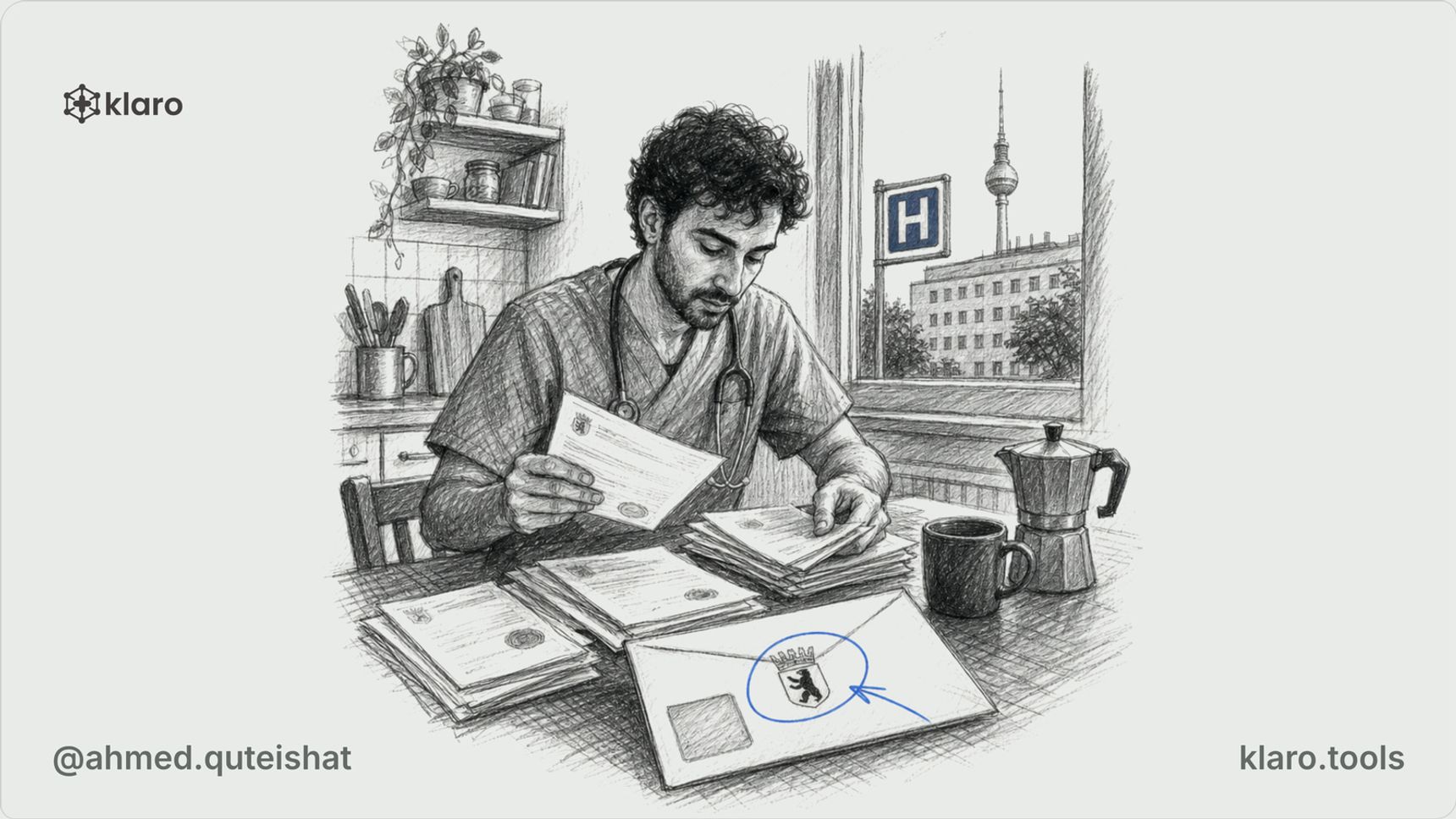
Non-EU doctors get Approbation in Germany by choosing one state office first and sending a complete, correctly certified file before booking exams. Approbation is the full German medical licence. The state authority checks your diploma, internship, work history, language papers, and personal certificates. Most lost months come from a file that has the wrong certification, an incomplete translation, or a certificate that expires before the authority reaches it.
There is no single German Approbation office. Each Bundesland, meaning federal state, has its own licensing authority. Berlin uses the Landesamt für Gesundheit und Soziales. North Rhine-Westphalia has separate district governments. Bavaria uses regional governments. You apply to one authority, not to every state at once.
1. Choose the state before you collect the file
Choose the Bundesland where you have a real reason to work, live, interview, or start a job. The authority wants to see that connection before it opens your file. A hospital interview invitation, an employment offer, a registered address, or applications to hospitals in that state are common ways to show it.
Do not choose a state because somebody online received Approbation there quickly. That person's diploma, exam route, language certificate, and authority workload were different. Your state decides which papers it asks for, how it handles the Fachsprachprüfung, and where you sit the Kenntnisprüfung.
What the state office checks first
The caseworker first checks whether your application form, passport, CV, diploma, transcript, internship papers, licence from your home country, and Certificate of Good Standing are present. The Certificate of Good Standing is the paper from your licensing body showing that you are allowed to practise and have no current professional restriction. A missing page can stop the file before anyone compares your medical education.
2. Build the file exactly as the authority requests
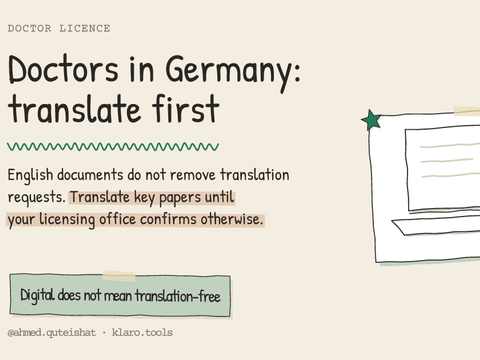
Send the papers in the format named on the authority's checklist. That usually means certified copies for the diploma and passport, plus German translations from a sworn translator for Arabic, Persian, Turkish, Urdu, or other non-German documents. A scan of a stamp is not the same as a certified copy.
Your CV needs dates by month, city, hospital, specialty, and job title. Write the gap between your internship and your current work plainly. For example: "06/2023 to 10/2023, preparation for German language examination, Cairo." A caseworker who sees an unexplained 5-month gap sends a request for clarification instead of moving to the next document.
- Use the checklist from your own state authority, not a checklist from a Facebook group.
- Ask the translator to translate every stamp, handwritten note, and reverse side of the diploma.
- Keep one PDF folder with the application form, each certificate, translation, and the email confirming submission.
- Check the issue date of the Certificate of Good Standing and medical fitness certificate before you send them.
3. The authority compares your medical education
After the file is complete, the authority compares your medical education with German medical training. For non-EU diplomas, the authority normally starts with an equivalence check. It looks at your university curriculum, clinical subjects, practical year or internship, and later medical work.
If the authority finds substantial differences that your papers do not explain, it asks you to prove your medical knowledge through the Kenntnisprüfung. The Kenntnisprüfung is the German medical knowledge exam. It is usually an oral-practical exam with internal medicine and surgery at its centre, plus emergency care, pharmacology, imaging, radiation protection, and legal duties.
A detailed transcript helps more than a one-line university letter. Send subject lists, hours, clinical rotations, internship certificates, and course descriptions when your state checklist permits them. A diploma says you graduated. A transcript and rotation certificate show what you studied on the ward, in theatre, and in clinics.
4. Pass the language stage before the medical exam
You need German language papers before you work with patients. States commonly require general German at B2 level and a medical language exam at C1 level. The Fachsprachprüfung is the medical language exam. It tests a patient conversation, a written medical report, and a doctor-to-doctor handover.
The organisation differs by state. In many states, the state medical chamber runs the Fachsprachprüfung after the licensing authority refers you. In other states, the authority accepts a named language certificate or uses another approved provider. Do not book a random C1 exam because a colleague used it in another Bundesland.
The common failure is administrative, not grammar. Doctors send a B2 certificate to the chamber before the licensing authority has opened their file, or they wait for an exam invitation before submitting the Approbation application. Submit the licence file first. Then follow the written instructions from your authority and chamber.
5. Berufserlaubnis can let you work while Approbation continues
A Berufserlaubnis is a temporary permission to work as a doctor under conditions set by the state. It is not Approbation. Some non-EU doctors use it for a hospital job while preparing for the Fachsprachprüfung or Kenntnisprüfung.
The permission is tied to the state and may be tied to a named hospital or specialty. A junior doctor with a Berufserlaubnis in a clinic in Saxony cannot assume they can move to Hamburg with the same paper. The new state authority decides whether it will issue its own permission.
6. The final decision is a licence, an exam notice, or a request
The authority does not stay silent because your file is being ignored. It moves through concrete steps. You receive a request for missing papers, an instruction for the Fachsprachprüfung, a notice about the Kenntnisprüfung, a Berufserlaubnis decision, or the Approbation certificate.
Read every letter from the authority on the day it arrives. A request may name one missing document, such as a new Certificate of Good Standing or an original internship certificate. Send exactly that paper with your file number in the email subject. Sending 20 unrelated attachments makes the caseworker search the file again.
What to do this week
- Choose 1 Bundesland where you can show job applications, an interview, an address, or a hospital offer.
- Download that authority's Approbation checklist and make a folder for every item on the list.
- Order a new Certificate of Good Standing from your medical council or licensing body.
- Book a sworn translator for your diploma, transcript, internship certificate, licence, and work certificates.
- Email the state authority one precise question if its checklist is unclear: "Do you require certified copies of my internship certificates and course descriptions for my Approbation application?"
Stand: 2026-09-26. This is a guide, not legal advice. Every German state has its own rules, and rules change. Check with your state's [medical chamber (Landesärztekammer)](https://www.bundesaerztekammer.de/aerztekammern) before you act.
Ahmed Quteishat — Founder, Klaro
Ahmed built Klaro after watching how much of a doctor's move to Germany gets lost in paperwork rather than medicine.