Is Germany's Doctor Job Market Saturating for IMGs? The Data
Facebook groups keep saying the German market is full. Here's what the actual data on Ärztemangel and Fachärzte oversupply shows, specialty by specialty, region by region.
Ahmed Quteishat
Assistenzarzt, Innere Medizin (Berlin) · Founder of Klaro
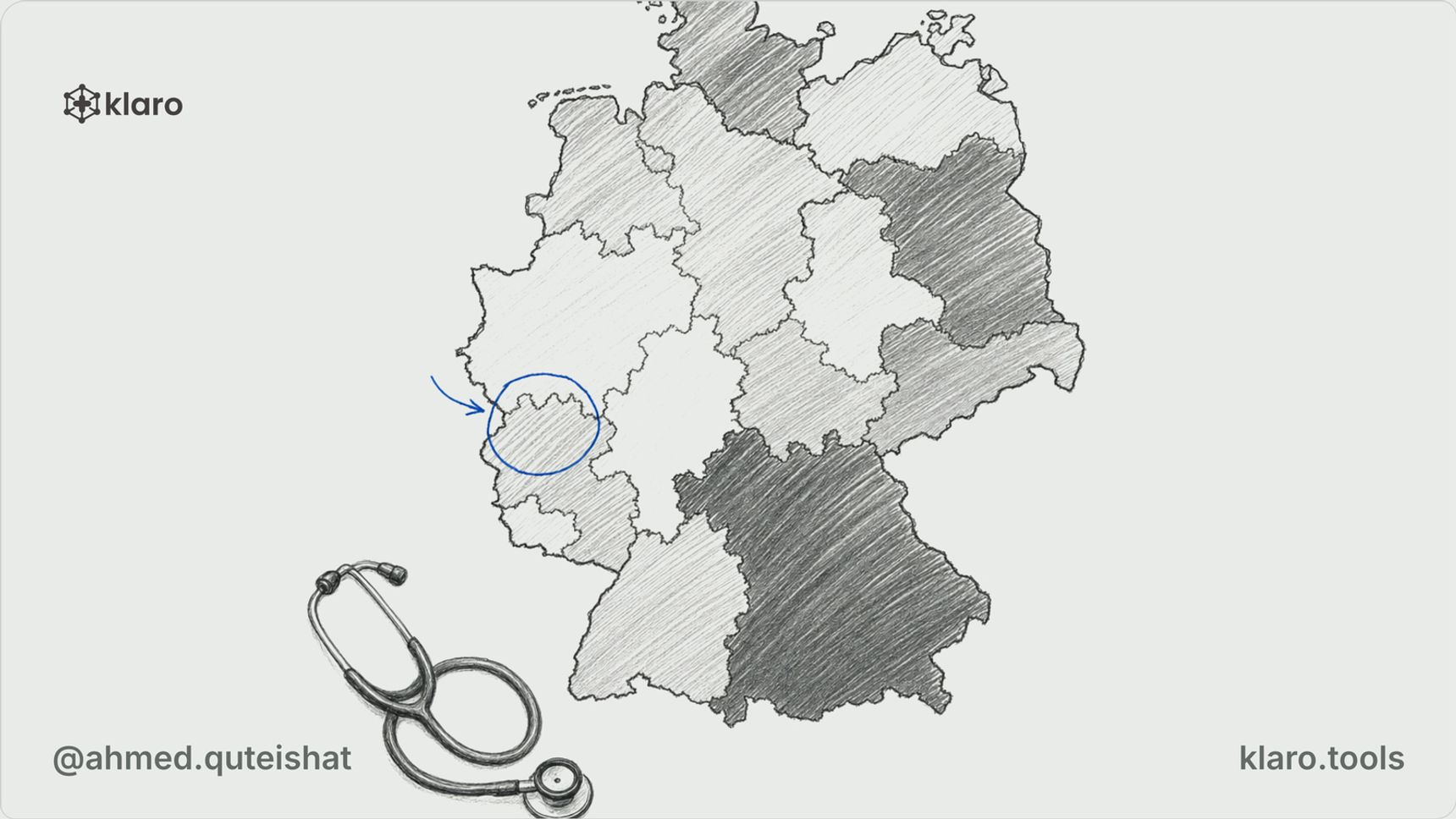
Every few weeks, someone posts the same thing in an IMG Facebook group: don't bother, the German market is saturated now, I know three people who couldn't find a Stelle. It gets fifty comments, half panic and half pushback, and nobody links to anything. So let's look at what the actual data says, not what one anecdote from one city implies.
What 'Saturation' Actually Means
Germany does not have one doctor job market. It has 17 Kassenärztliche Vereinigungen (KV regions, one per Bundesland plus a few splits), each running its own Bedarfsplanung, the formal process that decides how many outpatient specialist licenses (Kassensitz) a region is allowed to have per specialty. On top of that, hospitals hire Assistenzärzte through an entirely separate process with no such cap. Saying 'the market is saturated' without naming a specialty and a region is a bit like saying 'German weather is bad', true somewhere, on some day, and useless as a planning tool.
The age structure nobody panics about
The Bundesärztekammer publishes an annual Ärztestatistik that tracks, among other things, the age distribution of practising physicians in Germany. It is public, it is free, and it is the single best antidote to Facebook-group vibes. Look at it before you look at another comment thread.
Where the Squeeze Is Real
The panic isn't entirely made up. In some specialties, in some cities, outpatient practice is genuinely tight. Dermatology, ophthalmology, and psychotherapy in places like Munich, Hamburg, or Frankfurt often show KV regions officially marked as 'gesperrt' (closed to new Kassensitz applications) in the Bedarfsplanung data, because the ratio of specialists to population already meets or exceeds the planning threshold. If your plan is specifically to open an outpatient practice in a major city in a popular specialty, that part of the panic is grounded in something real, and worth checking region by region before you commit.
Where the Data Still Shows Gaps
That is one slice of the market. It is not the slice most IMGs are actually entering. Most internationally trained doctors start as Assistenzarzt in a hospital, working toward Facharzt, and hospital residency positions are not capped by Bedarfsplanung at all. Hospitals hire based on their own staffing needs, and plenty of them, especially outside the biggest cities, report unfilled Assistenzarzt positions year after year. Rural and eastern regions, and specialties like general/family medicine, general internal medicine, and psychiatry, consistently show up in shortage reporting from the KBV and regional health ministries. The Ärztemangel is not evenly distributed, and it has not disappeared just because a few urban specialties got crowded.
A 3-5 Year Outlook, Not a National Verdict
If you want a realistic medium-term picture, think in two axes at once, specialty and region, not one national yes-or-no answer:
- Hospital-based Assistenzarzt roles in rural and smaller-city hospitals: demand looks stable to rising over the next few years, driven by an aging domestic physician workforce reaching retirement faster than German medical schools produce replacements.
- General/family medicine, internal medicine, and psychiatry almost anywhere outside the largest metro centers: reporting continues to flag these as understaffed.
- Outpatient Kassensitz specialties in Munich, Hamburg, Frankfurt, and similar cities, particularly dermatology, ophthalmology, and psychotherapy: this is where 'closed' regions in the Bedarfsplanung are most common, and where a new IMG competing purely on a city-center Kassensitz will feel real competition.
- Surgical subspecialties and highly sought Facharzt titles in university hospitals in top-tier cities: competitive for everyone, German-trained doctors included, and not really an 'IMG saturation' story so much as an 'everyone wants that job' story.
None of this is static. Bedarfsplanung gets revised, retirements accelerate or slow, and a region that looks tight this year can open up as older physicians step back. That is exactly why a 3-5 year outlook has to stay a moving target you check yourself, not a fact someone posted once.
How to Check This for Yourself, Not a Facebook Poll
You don't have to take anyone's word for this, including mine. The primary sources are public:
- Bundesärztekammer Ärztestatistik, for age structure and total physician numbers by region and specialty.
- KBV Bedarfsplanung and Versorgungsatlas, for which specialties are officially 'open' or 'closed' for new Kassensitz in each KV region.
- Individual Landesärztekammer and regional health ministry reports, which often publish their own Ärztemangel figures for their Bundesland.
If you are specifically weighing a hospital Stelle rather than an outpatient practice, the more useful signal is simply which hospitals are actively posting Assistenzarzt openings right now, and in which regions. That's the kind of live picture Klaro's job search is built to show, sorted by specialty and location, rather than a snapshot from a Bedarfsplanung report that might be a year old.
So: is the German market saturating? In a handful of outpatient specialties, in a handful of big cities, yes, somewhat. Everywhere else, the underlying demographic pressure that created the Ärztemangel in the first place hasn't gone away. Check the region and specialty you actually care about before you let a comment thread decide your plans.
Stand: 2026-09-10. This article is orientation, not legal advice. Rules differ by Bundesland and change — always confirm with your [Landesärztekammer](https://www.bundesaerztekammer.de/aerztekammern) before acting.
Ahmed Quteishat — Assistenzarzt, Innere Medizin (Berlin) · Founder of Klaro
Ahmed built Klaro after watching how much of a doctor's move to Germany gets lost in paperwork rather than medicine.